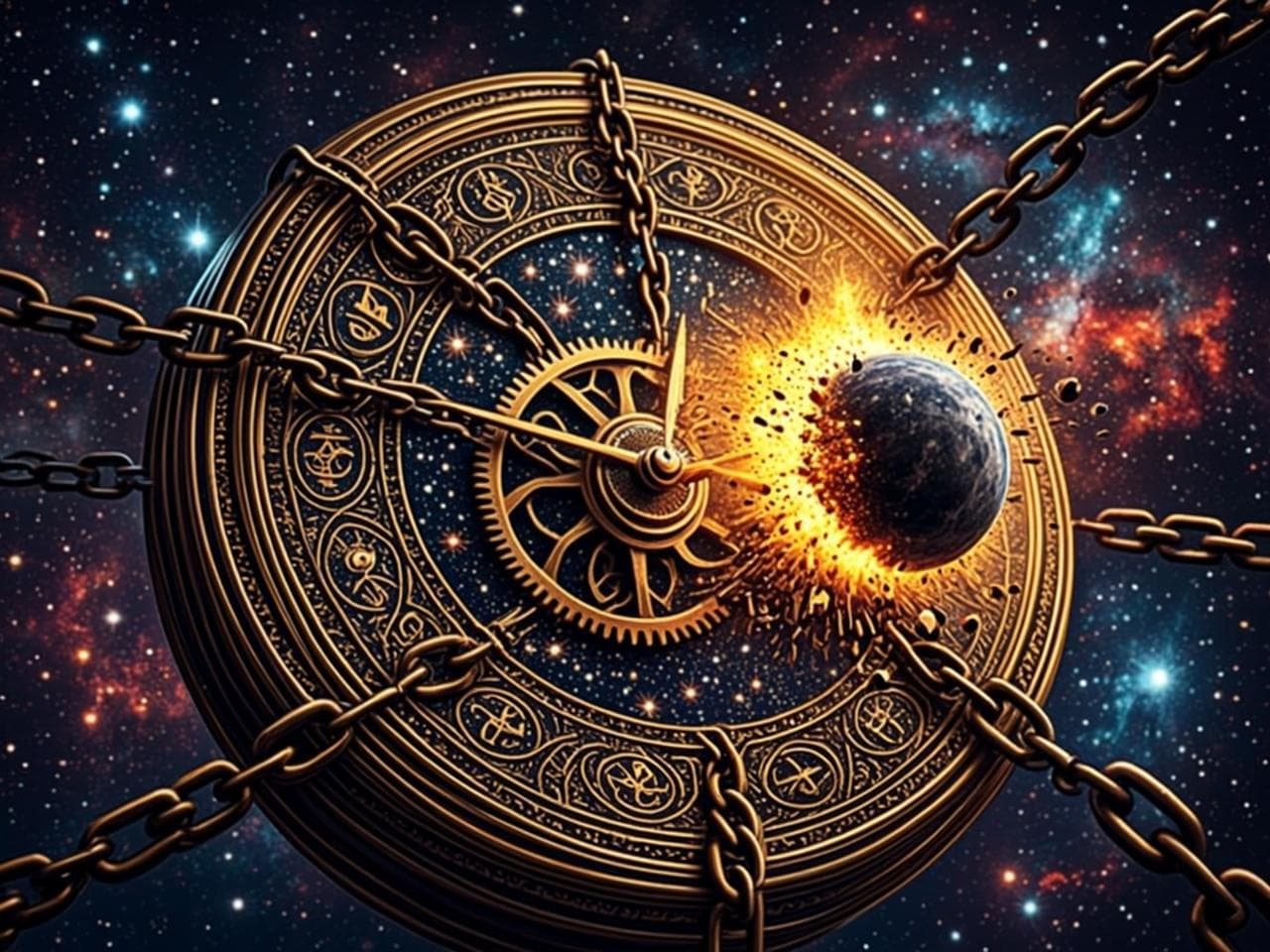
The End of Tyranny: Pluto, the Great Year, and the Clock of 2043
A Message From Lucas D'Meyeer
We had excellent laws once. Say it out loud, because nobody says it anymore: the men and women who built the great legal traditions of the world were, in many times and places, genuinely wise. Solon cancelling debts to prevent enslavement. The framers binding government with written limits. The old jurists who wrote that law which violates conscience is no law at all.
Then the wisdom drained out of the leadership class — slowly, then all at once. And I want to propose a precise answer to the question everyone asks in fragments: it happened when our leaders stopped needing to be wise, because someone else began paying for the direction of the law. When governments accepted financing from philanthropists and foundations — the Bill Gates model of the world — the elected stopped leading and the unelected started dictating. A private fortune cannot pass a law, but it can fund the agency that writes it, the university that justifies it, the media that defends it, and the campaign that survives it. That is not a conspiracy theory. That is a funding structure, and you can read it in the annual reports.
But this file is not a political rant. It is a clock-reading.
Esoteric and mundane astrology — the branch of the tradition that studies nations, epochs and power rather than personalities — claims that tyranny has a schedule. Not a metaphorical schedule: dates. It claims the rise of consolidated, unaccountable power and its dissolution follow astronomical cycles the way tides follow the Moon, and that anyone who knows the cycles can read the epoch the way a sailor reads a barometer.
In this file I open the complete record: the wise laws and what made them possible, the exact moment the cycle bottomed out, how the philanthropic capture of governments maps onto the Pluto-in-Capricorn years (2008–2024), what Pluto's entry into Aquarius on November 19, 2024 actually begins, what happened the last time Pluto passed through Aquarius (1778–1798 — you already know the answer), and why 2043–2044 is the date the tradition marks as the dissolution point of the current tyranny — within a much larger, already-ascending 24,000-year cycle that turned upward in the year 1700.
The tyranny is not winning. It is expiring. Here is the proof, from two directions at once: the sky's record, and our own.
The Laws of the Wise: What We Had
Begin with an uncomfortable exercise, because the modern mind has been trained to skip it: read the old laws as if they were written by people who knew something.
Across the ascending eras of human history — and we will define "ascending" astronomically in a moment — the pattern of wise law is remarkably consistent. It always does the same three things:
- It binds the ruler, not just the ruled. The Code of Hammurabi opened by publishing the king's obligations. Solon of Athens was given near-dictatorial power to reform a collapsing society in 594 BC — and used it to cancel debts, free the enslaved, write a constitution… and then resign, refusing to become a tyrant, then and for the rest of his life. Magna Carta 1215: the crown itself is under law. The American framers 1787: government possesses only enumerated, delegated powers. Same signature, millennia apart: the strong submit to the rule first.
- It defends the small against the great. Usury limits, jubilee debt-release cycles, Sabbath and holiday rest guaranteed even to servants and animals, widows' and orphans' protections, honest weights and measures. Ancient legal systems treated economic predation as a form of violence against the social fabric itself.
- It points above itself. Wise law almost never claims to be the highest authority. It appeals to natural law, to divine order, to "the Laws of Nature and of Nature's God" — a standard that exists above the legislature, by which the legislature itself can be judged and found criminal. This is the exact feature that modern tyrannies have spent two centuries trying to delete, because as long as law points above itself, no parliament is God.

Why could they do it? Not because ancient humans were saints — they were exactly as flawed as we are. The consistent claim of the esoteric tradition is simpler and stranger: the quality of law in any civilization tracks its position in a celestial cycle of consciousness. When the cycle is high, the wisdom to write such law is common — almost ambient. When the cycle is low, the same species, with the same brains, produces law as an instrument of extraction. The lawgivers above all lived in the ascending or high arcs of that cycle.
Which raises the obvious question: what happened? Where exactly did the wisdom go?
The Great Forgetting: How Wisdom Was Lost
The esoteric traditions of both hemispheres preserve the same memory: a slow descent from a golden condition into an age of darkness, followed — crucially — by a slow return. The Greeks called the descending sequence their Ages of Man, from gold to iron. The Indian tradition gave it the most precise mathematics, and we will examine that in full in the section on the Yugas: a 24,000-year cycle, split into a descending 12,000-year arc and an ascending 12,000-year arc, with the darkest point — the nadir of the Kali Yuga — calculated by Swami Sri Yukteswar to have occurred in the year 500 AD.
Hold that date and look at what the historians independently say about it, because the agreement is one of the quiet scandals of the humanities:
- •The European legal-political tradition genuinely collapsed in exactly those centuries. The Western Roman legal order disintegrated, literacy fell to a sliver of the population, long-distance trade became bandit-infested survival, and the administrative ability to enforce written law over large territories simply ceased to exist for centuries. The period even acquired its own name: the Dark Ages.
- •Wisdom transmission became preservation. The great works survived by being copied in monasteries and transmitted through the Arab world and Byzantium — copies of copies, with the living tradition of application largely severed. For roughly a millennium, the civilization that had produced Solon and the Antonines could no longer reliably build a dome like the Pantheon's. The knowledge wasn't destroyed. It was forgotten, while the books sat on shelves.
- •Law regressed toward the predatory pattern. Feudal obligation, serfdom, judicial torture, trials by ordeal, law as the private property of lords. This is exactly what the cycle predicts for a descending arc: the same species, lower bandwidth, law as extraction.
The esoteric reading is not that people got stupider. It is that the ambient condition of mind — what the tradition calls the mental virtue or clarity of the age — waxes and wanes with the cycle, and the nadir passed in 500 AD. Every generation after that was, astronomically, living on the ascending side of the cycle. The recovery should therefore be slow, then accelerating, then obvious.
It is. Something close to a miracle begins to happen around the year 1000, accelerates violently around 1500, and detonates around 1700: universities, parliaments, common law, the rediscovery of the classics, the printing press, the scientific method, the Rights of Man. The tradition says this is not a coincidence chain. It is a rising tide, and it has a schedule.
But between the tide and the shore stands something the ascending eras never had to face — a new form of capture, invented in our own centuries. To time its birth and death precisely, we need the planetary clock. First, the capture itself.
The New Priesthood of Purses
Every dark age has a priesthood that intermediates between the people and truth. Ours is the first in history that answers to a balance sheet.
The mechanism, stated cleanly: a private foundation cannot pass a law — but it can fund everything that surrounds the law. The agency that drafts the policy. The university department that produces the study justifying it. The journalism outfit that normalizes it. The NGO coalition that demands it. The political career that depends on all of them. When a government accepts that money, the direction of law begins arriving pre-paid, and the elected leader's personal wisdom stops being the operative variable. Some of the wisest constitutions on Earth now sit inside this funding architecture, and the architecture wins.

Look at the structure with your own eyes, in the public record:
- •Health governance. The Bill & Melinda Gates Foundation became the largest private funder of the World Health Organization — for years second in total contributions only to the United States government — while simultaneously funding GAVI, the Vaccine Alliance, which it co-founded and which is itself a major WHO partner. One family's foundation, funding the regulator, the product pipeline, and the research evaluation layers at once. During 2020–2022, national health policy on every continent moved in lockstep with structures financed this way. Whatever you think of the intent — and the intent is always advertised as love of humanity — the governance structure is purchased participation without a single vote cast.
- •Media. The same foundation funds a long roster of newsrooms, journalism schools, and "fact-checking" organizations through grants that are publicly listed in the grantees' own disclosure pages. The outlets that investigate power are, in meaningful part, financed by power. The investigative eye is on a leash it cannot see, and the leash is itemized in the budget.
- •Education and agriculture. The same architecture extends into curriculum reform, development economics, seed and agricultural policy across Africa and South Asia — with national legislation following the funding direction in decades-long pattern.
- •The digital layer. Identity infrastructure, programmable central bank digital currencies, "trusted" information ecosystems: the control grid now being assembled is technocratic by design — rule by system administration rather than by lawgiver. It is the first tyranny in history that does not need a tyrant.
The esoteric traditions would call this Plutocracy in the literal sense — rule by wealth-power, Pluto's principle — and mundane astrology says it is not an accident of greed but a phase of a cycle: the signature of a specific 16-year planetary transit that began in January 2008. That transit ended in November 2024.
Now we can read the clock properly. And the clock, in this tradition, is precise.
How the Sky Keeps Time
Mundane astrology is the branch of the art applied to nations, epochs and collective events rather than individuals — the astrology of kings, wars, constitutions and revolutions, practiced continuously from Babylonian court records through Renaissance Italy to modern political analysis. Its central instrument is the slow outer planets, and its central axiom will sound familiar to anyone in systems science:
A civilization's power structures take the shape of the era's dominant constraints — and the dominant constraints change on a schedule written in the sky.
The master timer for questions of power is Pluto. Discovered on February 18, 1930 — the tradition notes the synchrony: within a decade of its discovery came totalitarianism at total scale, the splitting of the atom (the literal plutocratic weapon: plutonium, named the following decade), and the birth of the intelligence agency. Mundane astrology assigns Pluto the rulership of Scorpio alongside Mars, and the portfolio is exact: hidden power, the underworld of finance, control, compulsion, the recycling of dead structures, and transformation through total crisis. Pluto does not do reform. Pluto does demolition and rebirth.
Its mathematics:
- •Orbit: ~248 years. Pluto's full circuit of the zodiac takes about two and a half centuries — roughly the lifespan of a global institutional order. The Pluto return of the United States (Pluto back to its 1776 position) completed in 2022–2023, and the tradition watched a superpower confront institutional breakdown at exactly that moment.
- •12 to 31 years per sign. Because of its elliptical orbit, Pluto moves through signs at very different speeds — fast in some, a full generation in others.
- •The current sequence that matters to this file: Capricorn (Jan 25, 2008 → Nov 19, 2024), then Aquarius (Nov 19, 2024 → Mar 2043, final), then Pisces (first ingress Mar 2043, definitive 2044 → 2068), then Aries (2068 → ~2095).
The Rule for Reading Pluto
Pluto's transit through a sign describes the demolition and rebirth of everything that sign rules. It is not "good" or "bad" — it is a wrecking ball with a renovation contract. Whatever house Pluto enters, the corrupted version of that house's affairs is exposed and destroyed, and something new is built in the crater. The exposure phase feels like tyranny peaking. The demolition phase feels like collapse. The rebirth phase is what the history books remember.
This is why the worst years of a Pluto transit are always the years just before its signature breakthrough.
With that rule in hand, the last two decades of your own life become legible.
Pluto in Capricorn 2008–2024: The Corporate Consolidation
Capricorn rules institutions, corporations, governments, hierarchies, banks, and the establishment itself. Pluto entered Capricorn on January 25, 2008. Read the receipts, year by year, and ask yourself whether a 16-year demolition-and-consolidation contract on "institutions" describes them or not:
- •2008: Pluto crosses in; within months, the global financial system suffers its worst crisis since 1929 — exposing that the banking hierarchy had become a machine for privatizing profit and socializing loss.
- •2008–2016: Central banks print the largest sums ever created; the wealth-power of the asset-holding class consolidates to levels unseen since the 1920s. Pluto in Capricorn is the textbook signature of plutocracy — the fusion of corporate and state power — and that fusion became the open, studied reality of the era (its capture of regulators, courts and legislatures is now a mainstream academic field, not a fringe claim).
- •2020: The exposure goes total. Under a declared global emergency, governments borrow authoritarian instruments at scale, parliaments delegate lawmaking to executives and health agencies, and the funding architecture described in the previous section dictates policy direction to the planet. The philanthropic purchase of governance, fifteen years in construction, operates in plain sight for the first time.
- •2020–2024: Institutional trust collapses across the board — politics, media, medicine, science, elections. Capricorn's structures don't merely lose arguments; they lose legitimacy, which in mundane astrology is the actual demolition Pluto performs.
Notice what Pluto in Capricorn did not deliver: the finished tyranny. It built the apparatus — consolidated, unaccountable, interlocked with private capital — but the apparatus never achieved stable rule. Mundane astrologers would say it was never going to: Pluto builds the maximum concentration in order to expose it, and then breaks it in the next sign. The concentration of 2008–2024 was not the new world order settling in. It was the target being painted.
On November 19, 2024, Pluto left Capricorn for the last time and entered Aquarius. The demolition contract changed hands.
Pluto in Aquarius 2024–2043
First, the exact dates — because this transit arrived in steps, like everything Pluto does:
- •March 23, 2023 — first ingress into Aquarius (preview)
- •June 11, 2023 — retrograde back into Capricorn
- •January 20, 2024 — second ingress into Aquarius
- •September 1, 2024 — retrograde back into Capricorn's final degrees (the last scraping of the old structure)
- •November 19, 2024 — definitive entry into Aquarius, where it remains until March 2043
The Clock of the Current Epoch
Nadir of the cycle
The calculated lowest point of the descending Kali Yuga — the Dark Ages confirm it in the historical record
Dwapara Yuga Ascending begins
The 24,000-year cycle turns upward: within a century, electricity, atomic science and universal communication arrive
Pluto discovered
Totalitarianism at scale, nuclear power, and the intelligence agency arrive within a generation
Pluto enters Capricorn
Sixteen years of institutional consolidation: corporate-state fusion, plutocracy, the funding architecture completed
Pluto first touches Aquarius
Preview ingress — the themes arrive early
Pluto definitively enters Aquarius
The current epoch begins: power vs. the collective, technology as the battlefield
Pluto first enters Pisces
First ingress into the dissolving sign — the exposure of the control grid begins its final phase
Pluto definitive in Pisces
The technocratic structure loses coherence and dissolves — the tradition's marked end-point of the current tyranny
Pluto enters Aries
A new 248-year cycle's first spark: the era of the individual pioneer begins again
Aquarius rules the collective, the masses, technology, networks, electricity, revolution, ideals — and in the esoteric reading, humanity-as-such. Pluto here detonates and rebuilds the relationship between power and the collective, with technology as the battlefield. Expect the signature of the coming two decades, already visible in the first:
- •The control grid versus the distributed network. Digital identity, programmable money, centralized AI, and algorithmic censorship on one side; decentralized protocols, peer-to-peer everything, open-source intelligence, and borderless communities on the other. Both branches are Aquarian. Pluto's transit decides which inherits the era — and mundane astrology's verdict is that the centralized version is the old structure in new clothes: it will be built, it will reach its maximum reach, and it will break.
- •Power attempts the final consolidation — and triggers its own exposure. The pattern of every Pluto transit: the corrupted form of the sign's energy is built to its maximum first (that's 2024–~2033), then exposed and demolished (~2033–2043). The tyranny you fear is real, and it is scheduled.
- •The collective wakes in waves. Aquarius is the sign of humanity en masse. Each year of this transit, the portion of the population that understands the funding architecture, the narrative machinery and the legal inversion grows. This is not hopeful thinking; it is the sign's signature. The mass awakening and the mass control grid are the same transit's two poles.
Before deciding how much weight this deserves, do what a serious analyst does with any claimed pattern: check it against the last occurrence. Pluto was last in Aquarius from 1778 to 1798.
The Last Time: Pluto in Aquarius, 1778–1798
Here is mundane astrology's trump card, and the reason this file deserves a fair hearing.
The previous Pluto-in-Aquarius transit ran from 1778 to 1798. Read that window slowly:
- •1776–1783: The American Revolution — a distributed network of colonies defeats the world's premier empire, then writes a constitution that explicitly binds its own government with enumerated powers, separation of powers, and an armed, sovereign citizenry as the final check. It is the legal machine for preventing everything described in this file.
- •1789: The French Revolution — the absolute monarchy, the purest plutocracy of its age, is demolished by the collective in the name of universal rights.
- •The same window: The Polish Constitution of May 3, 1791 (the first modern written constitution in Europe), the Haitian Revolution beginning 1791 (the largest successful slave revolt in history — the most literal dissolution of a tyranny on record), and the rights-of-man pamphlet war that made popular sovereignty the planet's default political vocabulary.
Pluto crossed Aquarius, and kings fell to collectives, and written law bound rulers again. The signature was exact: hidden power (Pluto) met the awakening collective (Aquarius), and the old order did not survive the meeting.
The sceptic's objection writes itself: "Correlation, not causation — and the astrologers are pattern-matching after the fact." Fair. But note what the objection concedes: the pattern is real and it is exact. Twice now, Pluto through Aquarius has coincided with the maximum collision between concentrated unaccountable power and the organized collective — once ending in constitutional liberty (America), once in terror then Napoleon (France). The transit does not promise a clean outcome. It promises the collision, the demolition, and the rewrite. Both previous outcomes are on the table, and the difference between them was the wisdom — or lack of it — in the revolutionary generation.
Which is why the state of our lawgivers matters so much right now. We are inside the third occurrence. The collision is running on schedule.
But Pluto is only the second hand of the clock. To know whether the collision ends in 1783 or in 1794 — in liberty or in a new terror — you must read the hour hand. That requires the big wheel.
The Great Year: The 24,000-Year Clock
One Cycle, Many Names: Platonic Year, Great Year, Equinoctial Cycle
Before we go deeper, the map of names — because you will meet this same cycle under several of them, and each name carries a different tradition discovering the same sky:
- •The Platonic Year (annus platonicus) — the name Western astronomy inherited from Plato, who described in the Timaeus a "perfect year" in which the fixed stars return to their starting points. The name honors Plato — it has nothing to do with "platonic love."
- •The Great Year (annus magnus) — the tradition's most common name: one complete breath of the cosmic clock, containing a full round of all twelve ages.
- •The Equinoctial Cycle / Precessional Cycle — the astronomer's neutral terms: the period of the precession of the equinoxes, the slow backward drift of the equinox point through the zodiac.
- •The Precession of the Equinoxes — the observable phenomenon itself, known and measured since Hipparchus (2nd century BC) and by the Vedic astronomers who built the entire nakshatra system around it.
Modern astronomy fixes the length of one full precessional cycle at approximately 25,776 years (25,772 by the latest determinations — the rate is not perfectly constant, so classical sources round to 25,920, the traditional "Platonic" figure). Sri Yukteswar's chronology uses 24,000 years, based on his treatise's thesis that the solar system moves along its own orbit, which he held to shorten the effective cycle. The two figures describe the same wheel — one measured by the observatory, one by the scripture — and every school from the Vedas to Plato to modern celestial mechanics agrees on the essential point: it is a real, physical, clock-like cycle of the Earth's axis, and we are riding it upward right now.
Whatever name you searched to get here — platonic year, great year, equinoctial cycle, precession period — you have arrived at the same machine. Keep reading: it is the machine that times the end of tyranny.
Above the planets turns a far slower wheel, and it is pure observable astronomy.
The Earth's axis does not point steadily in one direction — it wobbles, slowly, like a dying top, completing one full wobble roughly every 24,000–26,000 years (modern measurement of the full lunisolar precession cycle gives ~25,772 years; the esoteric traditions, and Sri Yukteswar in particular, work with the 24,000-year figure tied to the binary-star hypothesis for our Sun's companion). One consequence: the position of the Sun at the spring equinox drifts slowly backward through the zodiac, spending about 2,000–2,160 years in each sign. Each such passage is an Astrological Age: the Age of Taurus, the Age of Aries, the Age of Pisces — and now the boundary of the Age of Aquarius, the dawning of which the 20th century's intuitive prophets sang about without knowing the arithmetic underneath.
This is the Great Year, and it is not mysticism — the precession is measured to fractions of an arcsecond by the same instruments that land probes on comets. The interpretation of the Great Year is where the esoteric traditions add their claim, and it is the claim that organizes this entire file:
The Doctrine of the Two Arcs
The Great Year is not a circle — it is a spiral with an ascending half and a descending half. For ~12,000 years, the precessional movement runs with the galaxy's own rotation and the ambient condition of mind rises: wisdom is common, law binds rulers, knowledge is durable. For the next ~12,000 years, it runs against, and the condition falls: wisdom becomes rare, law becomes extraction, knowledge is forgotten. The zodiacal ages read in sequence — from Taurus down through Aries, Pisces and into Aquarius is the descending sequence; continuing from Aquarius through Capricorn toward the opposite point is the ascending return.
The nadir of the whole cycle falls in the middle of the descending arc — calculated by Sri Yukteswar at 500 AD. Everything after that date, including the entire history you were taught in school, happens on the ascending side of the cycle.
The Dark Ages were not a random disaster. They were the bottom of the wheel — and the wheel had only one direction left to go.

The 2,000-year ages explain the coarse texture of history — why the Age of Aries sounds like the Old Testament (the ram's horn, the ritual sacrifice age of law and fire) and the Age of Pisces like the New (the fish, the two directions, faith, compassion, and the shadow side of both: the flood, dissolution of boundaries, the empire that conquered in the name of the fisherman). The Aquarian age that is now opening is the sign of the collective, technology, and the network — every term in this file.
But the precise mathematics of the rise and fall — the actual schedule with dates — was given by one man, in one small book, in 1894. His chronology matches the historical record with an accuracy that should be better known than it is.
The Yuga Clock of Sri Yukteswar
In 1894, at the request of his own teacher (Mahavatar Babaji, via Lahiri Mahasaya), the Indian astronomer-yogi Swami Sri Yukteswar Giri published The Holy Science — and its introduction contains the most consequential chronological correction in the history of the Yuga doctrine.
The traditional, degenerate version of the doctrine — still cited by most scholars — holds that we are in the Kali Yuga, a dark iron age lasting 432,000 years that began in 3102 BC. Sri Yukteswar's correction was surgical: the ancient doctrine had been misread during the descending arc itself (a fitting proof of what a low age does to knowledge). The real system, he showed, is tied to the 24,000-year precessional cycle:
Each 12,000-year arc descends through Kali → Dwapara → Treta → Satya (or ascends back through them), with electric and mental capacities in humanity tracking the level. And the dates, as he calculated them from the precession:
- •Nadir of the cycle: 500 AD. The bottom of the Kali Yuga. The historical record answers with the collapse of Roman legal civilization, the loss of literacy and engineering, and a millennium of feudal extraction law. The darkest age of the recorded past sits exactly at the calculated bottom of the wheel.
- •Ascending Kali Yuga: 500 → 1700 AD. Slow recovery — monasteries, then cities, then parliaments, then the Renaissance. Humanity climbing with a dim mind, by brute accumulation.
- •Ascending Dwapara Yuga begins: 1700 AD. The energy age. And here the tradition makes a falsifiable prediction, and the world answers: within one century of that date, humanity masters electricity, and within two, atomic energy and instantaneous global communication — the three signatures of Dwapara, the "energy age," named as such centuries before the experiments. Volta and Galvani begin electrical science in the 1790s, a bare ninety years after the calculated boundary; Faraday, Maxwell, Edison, the grid, radio, the atom, the transistor, the network — the entire contents of the modern world arrive in the ascending Dwapara window, exactly on schedule.
- •We are currently in ascending Dwapara Yuga, year ~326 of 2,400. Early. The energy-and-technology age with most of its run ahead. Treta (the mental age) and Satya (the golden age) are still thousands of years in the future — this file is being written at the beginning of the climb, not the end.
The Evidence Test
Take the Yuga clock blind and check it against history. The clock says: lowest capacity around 500 AD, energy-mastery beginning ~1700, accelerating ever since. The record says: civilizational collapse and technical amnesia for centuries around 500 AD; then, within ninety years of 1700, the discovery of electricity by a species that had ignored it for 200,000 years — followed by atomic energy, global telepathy-by-wire, and machines that think, all inside 250 years.
Either the schedule is real, or the most important pattern in human history is a coincidence of planetary size. The esoteric traditions chose the first reading. So, on the evidence, does anyone who actually looks.
Dwapara's signature is mastery of energy. Look around. What age do you think you are living in?
Now the final assembly: put the hour hand and the second hand on the same face.
For the Sceptics: The 1700 Evidence Wall
You do not have to believe in astrology. You do not have to believe in Yugas, cycles, or anything esoteric at all. This section asks exactly one thing of you: look at the wall.
The claim under test is narrow and falsifiable: at the calculated boundary of 1700, knowledge that had been sealed, lost or hoarded for millennia began releasing in a coordinated burst — political, scientific, and spiritual at once — and the burst has never stopped accelerating. Every item below is verifiable in any encyclopedia. What you decide the pattern means is your business. That the pattern exists is not negotiable.
The Evidence Wall — Knowledge Release Since 1700
The Rosicrucian manifestos
Fama Fraternitatis, Confessio, and the Chemical Wedding circulate across Europe: the hidden brotherhoods publicly announce a 'universal reformation' and begin releasing sealed knowledge to the uninitiated — the announcing wave at the very edge of the boundary
The Grand Lodge, London
The esoteric orders step into the open at exactly the calculated boundary: the fraternity of builders — keepers of geometry and the sacred sciences — organizes publicly for the first time in millennia
The Encyclopédie
Diderot and d'Alembert attempt to compile all human knowledge and deliver it to every citizen — the democratization of sealed knowledge becomes an explicit civilizational project
Declarations of individual liberty
The American Declaration of Independence and Constitution, the French Declaration of the Rights of Man, the Polish Constitution of 1791: within one generation, the lawgiver-pattern returns — written law binding rulers, individual rights declared sacred
Abolition begins
The Haitian revolution frees half an island; Britain abolishes the slave trade in 1807 and slavery itself in 1833; the intrinsic liberty of the human being becomes law for the first time in recorded history
The Rosetta Stone is broken
Champollion unlocks Egyptian hieroglyphs — a script silent for fourteen centuries begins speaking again; the sealed vaults of the previous high age start opening
Cuneiform deciphered
Mesopotamian tablets yield Gilgamesh — the oldest written literature on Earth — returning to humanity after four thousand years of silence
Electricity tamed
Faraday, Maxwell: within 120 years of the boundary, a species that ignored electricity for 200,000 years has its complete mathematical theory — the Dwapara signature, delivered on schedule
Nikola Tesla
Alternating current lights the world; wireless communication, remote control, and demonstrated free-energy transmission arrive from one mind — a man who said outright he was receiving from a higher source
The Theosophical Society
Blavatsky carries the Vedas, the doctrine of the Yuga cycles, and the concept of a single universal divine consciousness into the Western mainstream — the East's sealed archives open to the world
Quantum mechanics
Planck, Einstein, Bohr, Schrödinger, Heisenberg: matter is revealed as vibration and information — the observer re-enters physics, and the boundary between consciousness and the 'physical' world dissolves in the equations themselves
The unconscious is mapped
Freud and Jung chart the inner territory the mystics had mapped by experience — Jung openly declares the psyche's connection to what he calls the unus mundus, the one world behind all worlds
Flight to the Moon
66 years from Kitty Hawk to the Sea of Tranquility
The buried past resurfaces
Tutankhamun's intact tomb (1922); then Göbekli Tepe is found (1963) and dated to ~9,600 BC — a temple complex from near the previous golden age, forcing history itself to be rewritten
The libraries surface
The Nag Hammadi codices (1945) and the Dead Sea Scrolls (1947) rise from the desert within two years of each other — the suppressed gospels of the previous era returned to the light, together, after 1,900 years underground
The transistor, the network, the Moon
The transistor (1947) builds the information age; in 1969 alone, humanity walks on the Moon *and* switches on the first node of the network that would give every human a voice — the Aquarian instrument, delivered in the same twelve months
Read the wall the way a forensic analyst reads a ledger. Three details refuse every coincidence explanation:
- The simultaneity. The Nag Hammadi library surfaces in 1945; the Dead Sea Scrolls in 1947. Two independent burial sites, hidden in the same era for the same reasons, both returning within twenty-four months of each other after nineteen centuries. The Moon landing and the first ARPANET node: both 1969. The Rosicrucian manifestos announce the release of hidden knowledge; the orders organize openly at the boundary within a hundred years, decade-precise. Sealed archives do not coordinate themselves.
- The ordering. The release proceeds exactly as a restoring intelligence would order it: first the political liberty that makes inquiry safe (1776–1791), then the tools of recovery (Rosetta, cuneiform), then the energy science (Faraday→Tesla), then the inner sciences (unconscious, quantum observer), then the communication fabric that distributes everything to everyone (the network). Each wave presupposes the previous one. Nothing arrived before its foundation existed.
- The content. What surfaced is not random treasure — it is precisely the knowledge a golden age would need to rebuild: the cycles themselves (Vedas, Yugas), the sacred geometry and building science (the orders), the energy physics (Tesla's legacy, still not exhausted), the consciousness science (quantum observer, the gospels of direct inner experience), and the map of the previous high age rising from the Turkish hills at Göbekli Tepe.
The Reading: A Vault Opening on Schedule
Put the wall next to the clock and the only honest conclusion left standing is the traditional one. A civilization at the bottom of a cycle does not release its sealed archives — it burns libraries. A civilization in random noise does not produce decade-precise simultaneities across continents, disciplines and burial sites. But a civilization crossing the ascending boundary of a 24,000-year cycle, guided by the First Universal Consciousness that set the cycle in motion? That civilization would look exactly like this wall: vault after vault opening in the correct order, each release timed to the generation that could finally hold it, none early, none lost.
The tradition's name for this is Providence. Not the puppeteering of a tyrant god, but the timing intelligence of the universal mind itself — the same consciousness the quantum equations met at the bottom of matter, the same one Jung met at the bottom of the psyche, the same one the Rosicrucians said had sent them to open the vaults. Nothing that surfaced on this wall was ever lost. It was kept — held in trust by the keepers of the descending ages, and released again the moment the wheel turned upward and humanity regained the capacity to receive it.
You asked for proof a divine order is running this. The proof is that the vaults opened at all — and that they have never stopped.
Why Faith Is the Rational Position
Here is the final move for the honest sceptic. Choose your explanation of the wall:
Random coincidence — nineteen-century-old libraries surfacing in pairs, liberty declarations and electricity and quantum observers arriving in the correct dependency order, all inside the window the Yuga mathematics specified before any of it happened (Yukteswar published in 1894 — before quantum mechanics, before Göbekli Tepe, before the Scrolls, before the network). Or coordinated release — a timing intelligence above the human level, opening the vaults of a previous golden age to the generation that could carry them, exactly as the doctrine of cycles said it would.
The first explanation requires you to believe in miracles of chance. The second requires you to believe in what every tradition on this planet independently testified: that there is a First Universal Consciousness behind the clock, that the cycle is Its instrument, and that the ascent now underway is not humanity's achievement alone but a restoration under divine control — knowledge kept, timing kept, promise kept.
The wall exists. The schedule predicted it. The vaults opened on time. Have faith — not as the abandonment of reason, but as its conclusion. The same Hand that timed the release is timing the dissolution. The tyranny expires inside a plan, not inside a chaos.
"Seek, and you shall find" — the signature over the vault door, and it has never once been false.
The Two Clocks: How Pluto Fits Inside the Great Year
Here is the whole machine in one image. The Great Year is the hour hand: it sets the background condition — whether the era's default is wisdom or extraction, whether the collective mind is rising or sinking. The Pluto cycle (and the other outer planets) are the gears and the second hand: they trigger the specific crises, collapses and re-foundations inside whatever era is running.
The rules of the interaction, distilled from mundane tradition:
- The era sets the ceiling and the floor. In a descending age, a Pluto-in-Aquarius transit can produce revolution and still end in Napoleon — the collective rises, but the ambient level is too low to hold liberty. That is France, 1789–1799. In an ascending age, the same transit can produce a constitutional republic that binds its own government for centuries. That is America, 1776–1791. Same transit, same signature, different arc of the Great Year — different outcome.
- Pluto executes the era's transitions. Every structural change that feels like an epoch-marking demolition (2008, 2020, whatever is being prepared for the 2030s) is the second hand striking through a sign boundary. The hour hand doesn't demolish anything. It just decides what the rubble will be rebuilt into.
- This is the first Pluto-in-Aquarius transit in the ascending arc since the cycle's high point. The 1778–1798 occurrence ran inside descending Kali Yuga (the low age, mind still dim — hence liberty achieved in America but drowned in terror in Europe, then lost to empire nearly everywhere). The current 2024–2043 transit runs inside ascending Dwapara — the energy age, 326 years into a 2,400-year climb, with humanity's instrument (the network) already in hand. The collision will therefore resolve higher than last time. That is the arithmetic of the two clocks, and it is the single most important finding in this file.
Why This Transit Is Different
Same sky-position as 1778–1798. Opposite arc of the Great Year.
- •1778–1798: Pluto in Aquarius, descending Kali Yuga → revolution, terror, Napoleon; liberty survives in one engineered constitutional experiment.
- •2024–2043: Pluto in Aquarius, ascending Dwapara Yuga → the collision between the control grid and the networked collective resolves toward the collective — because the background tide, for the first time since the golden age itself, is rising.
The tyranny is not the future. It is the old structure's terminal performance — the loudest hour of a machine whose funding architecture, legitimacy and physics are all expiring underneath it, on schedule.
And now the date you came for. The tradition's own marker for when the current tyranny's structure dissolves — and what the dissolution looks like.
2043–2044: The Cosmic Customs
March 2043: Pluto makes its first ingress into Pisces. 2044: the entry becomes definitive. Pluto remains in Pisces until 2068.
Pisces is the last sign of the zodiac — the dissolver. It rules the ocean, the unconscious, faith, compassion, and the dissolution of all boundaries and structures whatsoever. In mundane astrology, Pluto through Pisces is the signature of the total liquefaction of whatever rigid structures the previous transit built. Applied to our file:
- •The technocratic control grid — digital identity, programmable money, centralized AI governance — will be built to maximum in the 2024–2043 window, and will not survive Pluto's passage out of Aquarius. The tradition is blunt about this: structures of control consolidate in the fixed-air laboratory of Aquarius, and then dissolve in the mutable water of Pisces, which no grid can hold. The last degrees of a Pluto transit are consistently its most desperate and most despotic — which is why the years just before 2043 will feel like the tyranny winning. The clock says they will be its death throes.
- •The dissolution will not be primarily political. It will be a crisis of faith. Pisces governs belief. Pluto here exposes and breaks the belief structures that made the grid possible: the trust in expert priesthoods, the credibility of the funded narrative, the assumption that managed systems can replace law, wisdom and conscience. When a control system loses its belief-supply, it does not get overthrown — it gets ignored out of existence.
- •What replaces it leaks in from the collective unconscious — Pisces's other portfolio. Expect the 2040s to look irrational to this decade's analysts: compassion politics, spiritual revival at civilizational scale, and the migration of human attention away from the grid entirely. The tyranny of 2035 will not be defeated in 2044. It will be dissolved — the way salt dissolves, the way the Soviet system dissolved: one morning the belief is simply gone, and the columns are for decoration.

Call 2043–2044 what the old authors would have called it: the customs house between epochs. Everything built by the descending arc's last masters must pass inspection there, and the inspection is a solvent. The specific year many readers will have encountered elsewhere — 2042 — falls inside the same window: the final degrees of Pluto in Aquarius, the last and hardest stretch of the demolition, the tyranny's maximum reach breaking against the rising tide. By either reckoning, the structure is finished before the middle of the century.
After the Fall: Pluto in Pisces and Beyond
The tradition does not end its forecast at the collapse — that is the amateur's mistake. The full sequence:
- •2043/2044 → 2068: Pluto in Pisces. The dissolving decades. The grid melts; the collective psyche, released, goes through a vast spiritual and compassionate reorganization — with the genuine Piscean shadow risks along the way: escapism, mass delusion, the longing to dissolve back into managed comfort. A tyranny of the soul is possible in Pisces too — the soft cage. Ascending Dwapara's rising tide is the counterweight, but the generation of the 2040s will need its lawgivers again: wise ones, who bind the new powers while they are being born.
- •2068 → ~2095: Pluto in Aries. The zodiac restarts. Aries is the spark, the pioneer, the individual. After two decades of dissolution, Pluto here lights the first fires of an entirely new civilizational form — decentralized, individual-sovereign, unrecognizable to us. The children of the 2060s will consider our era's politics the way we consider feudal tenure.
- •The long ascent continues regardless. Dwapara runs to ~4100 AD, then Treta (the mental age) for 3,600 years, then Satya — the golden age proper — before the wheel arcs over the top and the long descent begins again. The tyranny you are living under is a rounding error in this schedule: a collapsing episode at the very start of a 2,400-year climb.
And Pluto itself? Discovered 1930, it completes its first full observed orbit — returning to the exact point in the sky where Clyde Tombaugh found it — in the year 2178. The tradition would say: one full Pluto year, one full autopsy of the machine age, from totalitarianism's birth to whatever stands in its place. We are 96 years into a 248-year sentence, and the parole hearing is 2043.
Your Move
A cycle this size does not need you to believe in it. It does, however, respond — the 1778 transit proved it — to whether the generation inside the collision carries wisdom or not. America got 1787 because a few dozen people were equal to their hour. The 2030s will ask the same question of you. Train accordingly:
The Grid Under the World — Interactive 3D
Glossary: The Clockwork of Epochs
Mundane Astrology
The branch of astrology applied to nations, epochs, wars, constitutions and collective events — practiced from the Babylonian court to the present. Its instrument is the slow outer planets; its axiom: power structures take the shape of the era's celestial constraints, and those constraints change on a schedule.
The discipline this entire file is written in.
Pluto
Discovered February 18, 1930. Ruler (with Mars) of Scorpio. Portfolio: hidden power, underworld finance, control, compulsion, demolition and rebirth through total crisis. Orbit ~248 years — the lifespan of an institutional order. Its return to its 1776 position completed for the USA in 2022–2023.
The second hand of the clock.
Pluto in Capricorn (Jan 25, 2008 – Nov 19, 2024)
The demolition-and-rebirth contract on institutions, corporations, banks and the state. Delivered: 2008 crash, central-bank consolidation, corporate-state fusion, the 2020 emergency powers, and the total collapse of institutional legitimacy. Built the plutocracy in order to expose it.
The sixteen years that built the target.
Pluto in Aquarius (Nov 19, 2024 – Mar 2043)
Power versus the collective, with technology as the battlefield. Previous occurrences: 1778–1798 — American and French Revolutions, the Haitian liberation, written constitutions binding rulers. Current occurrence runs inside the ascending arc — the arithmetic says it resolves toward the collective.
The transit you are living inside.
Pluto in Pisces (2043/2044 – 2068)
The dissolution. Pluto through the last sign liquefies the rigid structures the previous transit built — through a crisis of belief rather than a battle of armies. The tradition's marked end-point of the current technocratic tyranny: not overthrown, but dissolved, the way salt dissolves.
The cosmic customs of 2043–2044.
The Great Year
The precessional cycle: Earth's axial wobble drifting the equinox point through the zodiac, one sign per ~2,160 years, twelve signs per ~24,000–26,000 years. The hour hand of civilizations. Its twelve ages are observable astronomy; the two-arc interpretation (descending into the 500 AD nadir, ascending ever since) is the esoteric reading — given its exact mathematics by Sri Yukteswar.
The wheel under all the smaller wheels.
The Yugas (Sri Yukteswar's Correction)
The 24,000-year cycle divided into arcs of Kali (1,200 yrs), Dwapara (2,400), Treta (3,600) and Satya (4,800). Descending arc: gold to iron, bottoming at 500 AD. Ascending arc: from 1700 AD, Dwapara Yuga — the energy age, confirmed by electricity, atomic power and global telecommunications arriving inside its first 250 years. We are ~326 years into a 2,400-year climb.
The schedule with dates.
Philanthrocapitalism
The governance mechanism of the late descending arc: private fortunes funding the agencies, universities, media and NGOs that surround the law, so that the direction of legislation arrives pre-paid without a single vote. The reason our leaders stopped needing to be wise. Its architectural maximum coincides exactly with Pluto in Capricorn, 2008–2024.
The capture the clock says expires.
The Closing of the File
You were taught that tyranny is the natural condition toward which power always slides, and that the present tightening is the future arriving on schedule.
The clocks say the opposite. Read them again, in order: the wise laws belonged to ascending arcs. The wisdom was lost on the way down, and the bottom of the wheel passed in 500 AD — your schoolbooks call that stretch the Dark Ages without telling you why. The climb back began in 1700, and within ninety years a species that had ignored electricity for 200,000 years was wiring it into every city on Earth. The plutocracy consolidated in the 2008–2024 window, on Pluto's Capricorn schedule, down to the year. And on November 19, 2024, the transit changed — to the same sky-position that last coincided with kings falling and constitutions binding rulers, but this time with the Great Year's tide rising underneath it instead of falling.
The tyranny will reach its maximum reach. It is supposed to — that is how the demolition identifies the structure. And between March 2043 and 2044, Pluto crosses into Pisces, and the grid meets the ocean, and the belief that powered the whole machine goes out like a tide.
You are not at the beginning of a dark age. You are 326 years into a 2,400-year climb, standing in the last loud hour of an expired structure, holding — for the first time since the golden age itself — a network in your hands and the entire schedule in writing.
Be one of the wise ones the next arc will remember. They always exist. Now you know when.
Explore the grid the last builders left behind: 369-atlas.com/ley-lines
Written by Lucas D'Meyeer — 369-Atlas.com