The Master Key: Decalcify Your Pineal Gland and Switch On Your Dormant Superpowers
A Message From Lucas D'Meyeer
There is an organ in the exact geometric center of your brain that is built like an eye — photoreceptors, lens-like cells, a direct line of sight to the light through your skull. Every esoteric tradition on Earth named it the third eye. Modern anatomy textbooks confirm the hardware and then change the subject.
And for roughly a century, that organ has been under a chemical siege with no historical precedent: a industrial byproduct, added deliberately to the public water supply, which bonds to the gland's calcium matrix and never leaves. The gland that regulates your sleep, your hormones and — as every initiate tradition insisted — your perception beyond the physical, calcifies. It crystallizes. The antenna goes quiet.
In this article I open the complete file: what the gland actually is, the exact chemistry of the lock that was closed on it, the symbol that every civilization from Assyria to the Vatican carved in stone so you would one day recognize the organ, the one cheap, safe mineral — boron — that breaks the fluoride bond at its root, the hemisphere-connection exercises that rebuild the wiring, and the plasma field technology that accelerates the entire protocol.
This is not meditation theory. This is plumbing, chemistry and electricity. Read it like an engineer.
The Antenna You Were Born With
Begin with the anatomy, because everything else in this file depends on it.
The pineal gland is a pea-sized, pinecone-shaped organ sitting on the midline of the brain, directly behind and above the eyes. It is not brain tissue in the ordinary sense. It developed as a structure at the top of the skull — where reptiles and amphibians still keep a light-sensitive organ with a literal window of skin above it, the parietal eye. In the human lineage the organ sank inward and settled at the center of the skull, but it kept its original equipment: cells that structurally resemble the photoreceptors of the retina, and a wiring scheme that resembles an eye's, including a vestigial structure analogous to a lens.
It behaves like an eye in its function as well. It converts light information arriving through the retina into the hormone melatonin — the molecule of darkness, of deep sleep, of the body's entire temporal architecture. Every rhythm you have — sleep, repair, dreaming — is gated by this one midline organ. This is not esoteric literature; this is endocrinology 101.

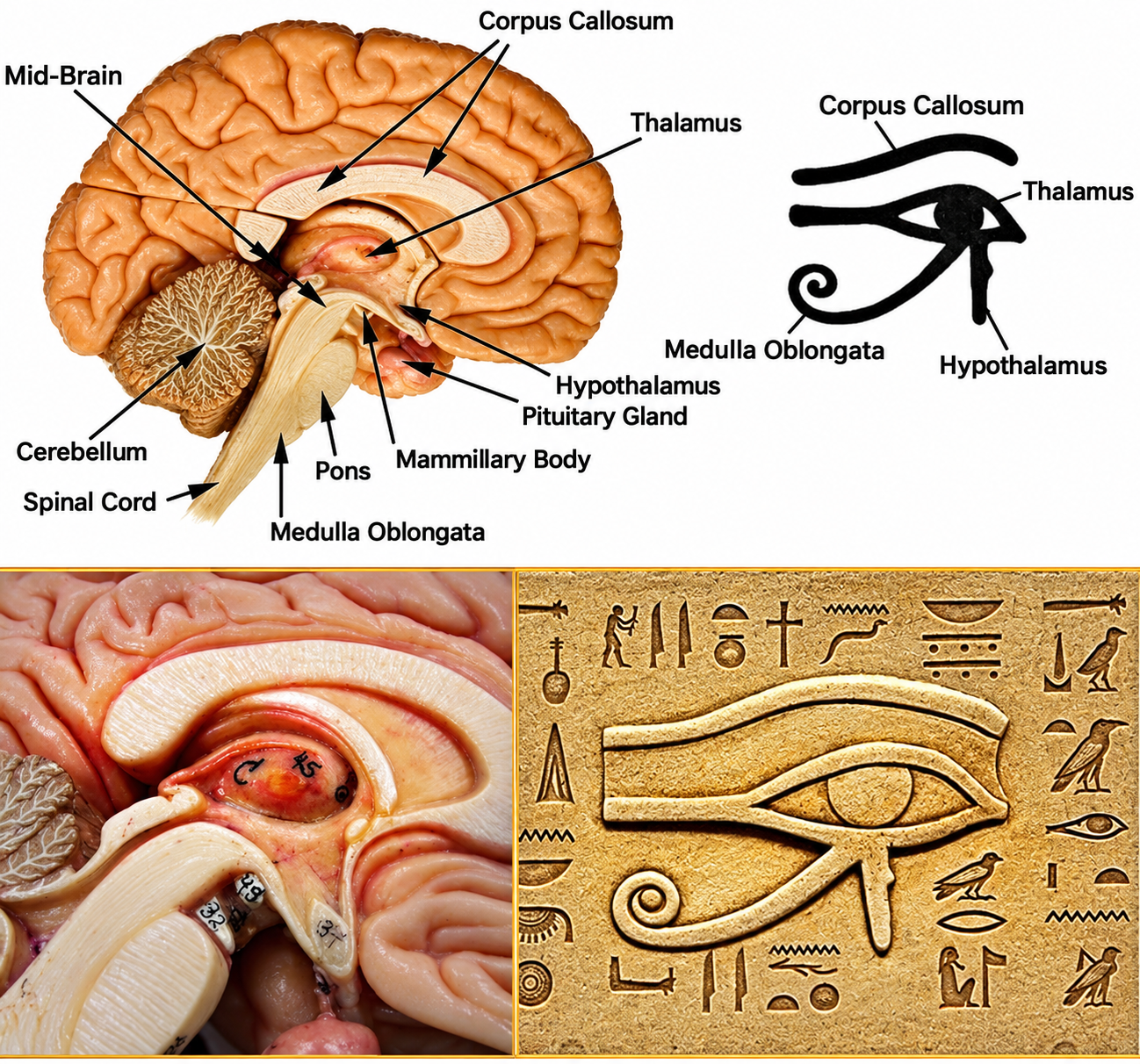
Now look at the image above with an engineer's eye. On one side, the modern anatomical plates: the gland suspended at the brain's core, its blood supply — remarkably rich for so small an organ — feeding it directly. On the other, the Eye of Horus, Egypt's most sacred symbol, drawn not as decoration but as a precise figure whose components map onto the gland and the structures around it. Two drawings, five thousand years apart, describing the same piece of hardware. The Egyptians did not guess. They knew the geography of the skull with a precision that still unsettles academic Egyptology, and they encoded the center of that geography into their holiest sign.
Descartes — the father of modern rationalism — called the pineal "the seat of the soul," the single point where mind interfaces with body. Every tradition that ever claimed a third eye, an inner vision, a perception beyond the physical, located that faculty in exactly this organ. When dozens of unconnected cultures converge on one small piece of hardware, you are not looking at coincidence. You are looking at a user manual, scattered across time, for an organ we stopped using deliberately.
Stopped using — and had locked. That lock has a name, and it is written on your water bill.
The Fluoride Lock
Here is the part of the file that changes how you see every glass of tap water for the rest of your life.
The pineal is not protected by the blood-brain barrier the way the rest of the brain is. It sits outside the barrier's tight seal, exposed to circulation — and it has a job that makes it a trap: it manages calcium. Over the years, the gland lays down calcium phosphate crystals — the same mineral family as bone — in a structure called hydroxyapatite. In a clean body this process stays slow and balanced. But the gland has one more property that turns it into a target: of all the soft tissues in the human body, the pineal is one of the most efficient concentrators of fluoride. Whatever fluoride circulates in your blood, the pineal accumulates — at levels comparable to bone and teeth, tissues that are designed to mineralize. The pineal is not. It is supposed to stay soft, dark and electrically active.
And fluoride does not merely accumulate there. It bonds. Chemically, permanently:
Ca₁₀(PO₄)₆(OH)₂  +  F⁻  →  Ca₁₀(PO₄)₆F₂  +  OH⁻
  Hydroxyapatite      Fluoride     Fluorapatite
  (pineal calcification)  (from water)  (a HARDER, more stable crystal)
That reaction converts the gland's soft calcium matrix into fluorapatite — a crystal that is harder and more chemically stable than the original deposit. This is precisely why fluorapatite is prized as a dental enamel hardener. On a tooth, that chemistry is sold as protection. Inside the center of your brain, the same reaction is a burial: the calcification locks into place, resistant to the body's normal clearance mechanisms, thickening year after year. By advanced age, the average pineal is a dense, gravelly crystal mass.
This is why meditation alone never fully restores the organ, why melatonin supplements only bypass it, and why standard chelation protocols barely touch it: heavy-metal chelators are built to grab mercury, lead, aluminum — they have no affinity for fluoride. Fluoride sits in the crystal, chemically bonded, laughing at your detox tea.
Every real decalcification protocol therefore answers one question: what breaks the fluorapatite bond? The frequencies of a multi-wave oscillator can shake the matrix loose (more on that below). The exercises rebuild the wiring. But the compound that grabs fluoride by the throat and drags it out of the body — permanently, chemically, in a way no other substance replicates — costs about ten euros a year and has been sitting in the chemistry set the whole time.
Its name is boron.
The Pinecone in Every Civilization
Before the protocol, one more piece of evidence — because the ancients left the proof that they knew exactly what this organ was, and they left it where nobody could miss it and nobody would look.

Study this collage panel by panel, because it is a lecture in image form:
Assyria. The winged sages — the apkallu — of Nineveh and Nimrud, carved three thousand years ago, are shown in the act of purification: in one hand a bucket of sacred water, in the other, held out toward the initiate's crown, an unmistakable pinecone. The object pointed at the head of man, by the bringers of knowledge themselves, is the exact shape of the gland in your skull.
Egypt. The Eye of Horus — the master symbol of healing and protection — with its distinctive midline structures tracing the gland and its nerve pathways, as the anatomy plate above makes explicit. And on the staffs of the gods and the headdresses of the pharaohs, the same pinecone finial, again and again.
Greece and Rome. The thyrsus — the staff carried by Dionysus and his initiates, the instrument of ecstatic altered states — is a stalk crowned with a pinecone. The symbol of the god of altered consciousness is a pine cone on a stick. There is no softer way to say it: they drew the gland on a staff and put it in the hand of the god of vision.
The Vatican. In the middle of the Pope's own courtyard — the Cortile della Pigna — stands a giant bronze pinecone, four meters tall, originally from ancient Rome, flanked by two peacocks, and now mirrored by a modern golden sphere whose interior is a sphere-within-spheres. The largest piece of pagan sculpture ever preserved by the Church is a monumental pinecone, placed at the very heart of the smallest state on Earth. Hidden in plain sight does not begin to describe it.
The East. The Buddha's crown — the ushnisha, the bump of enlightenment at the top of the head — and the pinecone-topped staffs and headdresses of Hindu and Buddhist iconography carry the same figure. And nature itself repeats the shape in the phyllotaxis spirals of actual pinecones and sunflowers — the golden-angle spiral, the same geometry the traditions associate with the awakening organ.
Four continents. No contact between most of these cultures for millennia. And they all, independently, carved the same organ, crowned their gods with it, pointed it at the human head, and built monuments to it at the centers of their power. The simplest explanation is not a planet-wide coincidence of imagination. The simplest explanation is that they could feel it — and that the men who built religions out of what the initiated could feel made sure the memory of the organ would survive whatever came next. Including a century of fluoride.
They left you the map. Now here is how to take the territory back.
Boron: The Master Fluoride Eliminator
Of every compound in the world of pineal detox, boron is the single most targeted fluoride-eliminating substance known to science — dirt cheap, exceptionally safe, and working through a mechanism nothing else replicates. It is in my own daily stack at 5 mg × 2/day, and this section explains exactly why.

Mechanism 1: Direct Chemical Binding — BF₄⁻ Formation
Boron, circulating as borate, has an extraordinarily high affinity for fluoride ions. At physiological pH, borate captures fluoride to form tetrafluoroborate:
BO₃³⁻  +  4 F⁻  +  6 H⁺  →  BF₄⁻  +  3 H₂O
(borate)   (fluoride)      (tetrafluoroborate)  → EXCRETED IN URINE
Tetrafluoroborate is water-soluble, biologically inert, and rapidly cleared by the kidneys. Once fluoride is bound to boron, it cannot re-deposit in tissue. It is chemically captured and flushed.
And this happens systemically — including in brain tissue. Boron crosses into the central nervous system, reaches the pineal region, and binds fluoride in situ: directly inside the calcified territory you are trying to reclaim.
Mechanism 2: Fluorapatite Dissolution
Boron does not merely patrol for free fluoride — it actively dissolves the existing fluorapatite crystal:
- Borate ions penetrate the crystal lattice of the fluorapatite deposit.
- They displace fluoride atoms from the structure through competitive binding.
- The weakened crystal releases both calcium and fluoride into the surrounding fluid.
- Calcium exits through natural pathways; fluoride exits as BF₄⁻, in the urine.
It is the only known natural compound that actively reverses fluorapatite formation — undoing, molecule by molecule, the reaction that sealed the gland.
Mechanism 3: Magnesium Restoration and Calcium Rebalancing
The third action is indirect and decisive: boron restores magnesium while normalizing calcium.
| Boron's effect on mineral balance | Pineal impact |
|---|---|
| Reduces urinary magnesium excretion (~22%) | More Mg available to block new calcium deposits |
| Increases activated vitamin D (calcitriol) | Calcium goes where it belongs — bone, not soft tissue |
| Normalizes serum calcium | Less raw material for new calcification |
| Supports testosterone/estradiol balance | Endocrine environment the pineal operates in |
Magnesium is the body's natural calcium antagonist. When magnesium is adequate, calcium stays in bone — not in the soft midline gland. Boron is the mineral that makes sure you keep yours.
Mechanism 4: Anti-Inflammatory and Neuroprotective
Chronic low-grade inflammation is one of the engines of soft-tissue calcification — the inflammatory cytokine environment promotes hydroxyapatite deposition. Boron modulates the NF-kB inflammatory pathway (through a different molecular target than gold, with a similar quieting effect) — switching off the signal that keeps the gland encrusted. On top of that, boron's documented neuroprotective profile includes reduced oxidative stress in brain tissue, support for memory, attention and motor coordination — and EEG shifts toward alpha-theta dominance: the same band the deep states of meditation and MWO sessions operate in.
The Science — What the Studies Say
| Study | Finding | Relevance to pineal decalcification |
|---|---|---|
| Price et al. (1938) — Boron in Human Nutrition | First documentation of boron's essential role in bone health and mineral metabolism; deficiency causes calcium dysregulation | Foundation: without boron, calcium deposits uncontrollably in soft tissues — including the pineal |
| Nielsen (1990) — Boron and Mineral Metabolism | 3 mg/day reduced urinary calcium excretion by 44% and raised estrogen/testosterone | Mineral-balancing effect confirmed at low doses |
| Hunt & Nielsen (1981) — Boron–Magnesium Interaction | Boron spares magnesium and reduces its loss | Critical: magnesium is the #1 natural inhibitor of pineal calcification |
| Prousky (2017) — Borax as a Fluoride Detox Agent | Clinical review: boron (as borax/sodium tetraborate) binds fluoride and eliminates it through urine | Direct evidence of boron-fluoride binding and excretion |
| Wang et al. (2019) — Boron Supplementation and Cognition | Double-blind trial: improved cognitive performance and EEG patterns | The brain benefits directly — not just the bones |
| Reinhold et al. (1991) — Boron Deficiency and Brain Function | Deficiency impairs cognitive performance and brain electrical activity | The reverse proof: adequate boron = optimal brain function |
The Dosing Protocol
| Parameter | Recommendation |
|---|---|
| Form | Boron glycinate/citrate capsules, calcium fructoborate, or pharmaceutical-grade sodium tetraborate (borax) |
| Elemental boron per dose | 3 mg minimum — 10 mg maximum (elemental, not compound weight) |
| Starting dose (Week 1) | 3 mg elemental, once daily, morning |
| Active detox dose (Weeks 2–8) | 5 mg elemental, twice daily (morning + midday) — this is my own dose |
| Maximum acute dose | 10 mg elemental twice daily — short-term, 2 weeks maximum |
| Timing | Morning and midday, with food — never before bed (mildly energizing) |
| Cycling | 6 weeks on / 1 week off, or continuous at maintenance (3–5 mg/day) |
| Combine with | Nano-silver (chelates what boron loosens), magnesium (synergistic sparing), MWO (accelerates elimination) |
Converting compound weight to elemental boron — the number that matters:
| Form | % elemental boron | To get 5 mg elemental... |
|---|---|---|
| Borax (sodium tetraborate) | ~11.3% | ~44 mg borax |
| Boric acid | ~17.5% | ~28.5 mg |
| Boron citrate | ~10–12% | ~42–50 mg |
| Calcium fructoborate | ~2.5% | 200 mg |
| Boron glycinate capsule (3 mg) | by label | 1 capsule = 3 mg elemental — the easiest option |
Safety — Read This
Boron has an exceptionally wide therapeutic window. The NOAEL (No Observed Adverse Effect Level) established by the WHO is 17 mg/day elemental boron for adults — meaning even at 10 mg twice daily (20 mg total) you remain in safe territory. Acute toxicity requires 15–20 grams — a thousand times the therapeutic dose — and there are zero recorded deaths from boron supplementation in the medical literature. Respect the numbers, not the fear: this is one of the safest minerals on the table.
Why Boron Is Non-Negotiable
You could run MWO and plasma alone. You would get results. You could add the nano-colloids and get better results. You could add the neuro exercises and get structural rebuilding.
But if you skip boron, fluoride — the root cause that locks the calcification in place — remains chemically bonded inside your gland. The frequencies shake things loose. The silver chelates the metals. The gold amplifies the field. The exercises rebuild the pathways. Only boron specifically, deliberately and aggressively targets fluoride itself — the enemy that sealed the door in the first place.
At €8–15 for a year's supply, it is the highest-ROI supplement in the entire protocol. This is the master key.
Rewiring the Hemispheres
Chemistry clears the antenna. But an antenna is only as good as its wiring — and the wiring of the modern brain is deliberately split.
Your two hemispheres communicate across the corpus callosum, the great bridge of white matter between them. In most adults that bridge is underused: a lifetime of reading, screens and one-directional habits trains the hemispheres into lazy specialization, and the coherent, whole-brain states that the traditions associated with the awakened pineal — the states measured in deep meditators as symmetrical, synchronized alpha-theta across both hemispheres — becomes rare instead of default.
The correction is mechanical, not mystical: cross-lateral movement. Exercises that force both hemispheres to fire simultaneously, in coordination, retrain the callosum the way physical training rebuilds a tendon. The two videos below are the exact exercises: short, demanding precisely enough, and designed to be repeated daily. Watch them, then perform them with the video — they are harder than they look, and the difficulty is the mechanism.
The sequence matters: boron is dissolving the crystal, the exercises are laying down the wiring the cleared gland will use. What remains is the field that accelerates both.
The Colloid Litmus Test
The morning protocol calls for nano-gold and nano-silver every day — and the word doing all the work in those names is nano. Before the field, before the exercises, you need to know whether the liquids in your hand are actually what the label claims. Here the chemistry gives you a test that costs nothing and cannot lie: the color of the colloid is a direct readout of its particle size.
First, a precision the image below insists on and most sellers would rather you skipped: these are particles, not molecules. A colloid is metal — real gold, real silver — divided into microscopic particles suspended in water. They never dissolve and never stop being metal. And the diameter of those particles decides everything: how much reactive surface each gram of metal presents, whether the particles can slip between cells and into tissue, and whether they carry the electromagnetic signature of the protocol or clump like silt. The target is simple: every particle under 10 nanometers. Below that threshold, a colloid behaves like the protocol assumes — near-colloidal stability, maximum surface area, full bioavailability. Above it, you are paying gold prices for sluggish dust.
Why does size have a color? Because at the nanoscale, metal stops behaving like metal. Particles of gold and silver smaller than a wavelength of light interact with photons through surface plasmon resonance — the free electrons on the particle's surface oscillate with the light and scatter a specific portion of the spectrum. That scattered color depends on the particle's diameter almost linearly. A true nanocolloid is a functioning indicator in a bottle: hold it to white light and the plasmon tells you the size, no laboratory required.

Read it panel by panel:
| COLLOID | COLOR YOU SEE | PARTICLE DIAMETER | VERDICT |
|---|---|---|---|
| Gold | Bright ruby red | ~20 nm or smaller | ✅ This is the one. True nanocolloidal gold — the red is the plasmon signature of small particles |
| Gold | Deep red / crimson | ~40 nm | ⚠️ Acceptable, not optimal — surface area already falling |
| Gold | Magenta | ~60 nm | ❌ Too large — you are past the threshold |
| Gold | Purple / wine | ~80 nm | ❌ Reject — particles clumping toward bulk metal |
| Gold | Lavender / grey-pink | ~100 nm | ❌ Reject outright — this is gold dust in water, not a nanocolloid |
| Silver | Pale golden amber / yellow | ~10 nm | ✅ This is the one. The amber tint is the plasmon of sub-10 nm silver |
| Silver | Clear with faint tint | 10–30 nm | ⚠️ Borderline — verify with a laser pointer (Tyndall effect) |
| Silver | Milky white / grey | ~100 nm | ❌ Reject outright — large particles, and at this size chronic use carries the classic argyria risk |
The pattern to burn in: for gold, red is right and purple is wrong. For silver, amber is right and milky white is wrong. In both cases the failure mode is the same — the particles grew, the surface area collapsed, and the liquid drifted from nanocolloid toward suspended dust. Two honest caveats the chart itself carries: color also shifts slightly with concentration and particle shape, and a very dilute correct colloid can look almost clear — the color test proves size when it shows, not absence when it doesn't. But the failure colors never lie. Purple gold and milky silver are always bad news.
The two colors that end the purchase
If colloidal gold shows purple, lavender or grey-pink, or colloidal silver shows milky white or grey — the particles are too large for the protocol (60–100 nm and up). Do not use it. Large silver particles in particular are the documented route to argyria — permanent grey-blue skin discoloration. Sub-10 nm silver held to protocol doses has no such record. Size is not a detail; size is the entire safety profile.
Why does the rest of this file care so much? Because every instrument downstream assumes small particles. The nano-silver that chelates the mercury and lead the MWO field shakes loose can only present its binding surface if the particles are small enough to have surface left. The nano-gold that amplifies the coherence of the field works through that same plasmon behavior — a 100 nm clump does not resonate with anything, it just sits there being expensive. Sub-10 nm is not a marketing number. It is the difference between an instrument and a souvenir.
The Plasma Field That Shakes It Loose
Chemistry dissolves the bond. Wiring rebuilds the pathways. The third instrument works on the physics of the crystal itself.
In the 1920s and 30s, Georges Lakhovsky — working in the Paris hospitals — established the principle that every cell is an oscillator, and that health is the coherence of those oscillations. His multi-wave oscillator (MWO) broadcast a full spectrum of resonant frequencies simultaneously, so that every cell — each with its own natural frequency — could find and reinforce its own note. His clinical results with it were remarkable, and the technology's subsequent suppression is its own chapter of history. The lineage is documented in the declassified capsule file: deprivation opens the system, substitution feeds it. And it is not history for me — the machine I run daily is the original MWO, the resonant-antenna configuration with its high-frequency plasma bulbs, built exactly on that lineage.
Applied to a calcified pineal, the principle is direct. Fluorapatite is a crystal lattice — and a crystal in a rich resonant field responds to it. The multi-wave field does not "detox" anything by itself; it does something upstream of chemistry: it energizes the lattice, loosening calcium and fluoride from the deposit, so that the boron circulating in the tissue has free fluoride to capture and the magnesium has calcium to redirect. Loosened, captured, excreted — each instrument doing the one job the others cannot.

The photo above is the original MWO I use and demonstrate — my daily unit, in the exact configuration this protocol was built around: the resonant field for the whole-body foundation, and the plasma bulbs — high-frequency plasma, what I call harmonic oscillatory plasma: resonant plasma driven by the antenna field itself, the same lineage Lakhovsky pioneered — for focused local work.
And the wiring is exact, because in a Lakhovsky machine placement is the tuning. The first laser plasma bulb connects to the transmitting antenna on ring 12, counting from the outside in — the smallest ring of all: the innermost loop, where the highest frequencies of the spectrum converge. The second laser plasma bulb connects to the receiving antenna on ring 6, counted the same way, from the outside in: the mid-band loop that couples the bulb to the broad body of the field. One bulb rides the sharpest note of the instrument; the other rides its resonant center. Together they turn the antenna pair into a driven plasma system — the field feeds the bulbs, and the bulbs speak back into the field.
A session runs in two phases: the field phase to raise the whole system's coherence, then brief bulb work at the crown, where the emission is strongest at the point the tradition itself never stopped pointing to. The ancients pointed at the head with a pinecone. The physics points at the same place with a plasma bulb.
This original MWO is the machine, and it is available now. Not a preorder, not a render, not a roadmap — the same unit running in the photos, documented and for sale on the MWO page. If this file has convinced you the field belongs in your protocol, this is the door, and it is already open.
For those who want to see where the lineage goes next: the MWO 3.0 is the coming generation of the same technology — refined construction, modern high-frequency resonant plasma systems, the full Lakhovsky spectrum. Its full engineering file is documented separately. But hear me clearly: you do not need to wait for it, and I would not advise it. Calcification compounds while you wait. The original machine runs the complete protocol today — the 3.0 is an evolution for later, not a reason to postpone the work your pineal needs now.
Get the Original MWO
What about the MWO 3.0?
The MWO 3.0 — the next generation of this technology, currently in production — has its own full engineering file with the Lakhovsky lineage, the high-frequency resonant plasma system and the clinical reasoning. The waitlist is open for those who want the evolution. But the original runs this entire protocol today: explore the original MWO here, and the MWO 3.0 file is here.
The Full Stack
One protocol, four instruments, executed in the order the chemistry and the physics demand:
And how the instruments lock together:
The Decalcification Synergy
Energizes the crystal lattice — shakes Ca + F⁻ loose from the deposit
Captures F⁻ as BF₄⁻ — permanent urinary excretion
Chelates Hg / Pb / Al the field liberates alongside the fluoride
Amplifies the coherence of the entire field
Rebuild the hemisphere pathways the awakened gland will use
Redirects calcium back to bone — blocks new deposition
The transport medium for all of it — hydration is the plumbing
Six weeks on, one week off. Then run it again. The crystal did not form in a month, and it does not leave in one — but it does leave. That is the difference between this file and a thousand articles of incense and good intentions: every step here has a mechanism, and the mechanisms compound.
Your Move
You now hold the complete file: the organ, the lock, the key, the wiring and the field. What you do before closing this tab is the only part anyone can do for you.
Start with the cheapest, most decisive instrument. Order boron glycinate today — 3 mg capsules, two in the morning for the first week, then the 5×2 protocol. Stop drinking the tap water that holds the lock closed; spring or properly filtered, permanently. Tonight, perform exercise set 2. Tomorrow morning, set 1. Twenty-one days. Come back to the videos when the wiring holds.
And when you are ready for the field that ties the whole protocol together — the original MWO I run daily, available now — the door is open here. (The MWO 3.0 can come later; the protocol cannot wait.)
The ancients carved the organ in stone so you would recognize it. The chemistry was published in journals nobody reads. The key was on the shelf the entire time.
Turn it.
Glossary: The Decalcification Lexicon
Pineal Gland
The pinecone-shaped, light-sensitive endocrine organ at the brain's geometric midline. Converts light information into melatonin and regulates the body's temporal architecture. Concentrates fluoride more than almost any other soft tissue — the biological fact at the root of this entire file.
Definition reflects the organ that Assyria, Egypt, Greece, Rome, the Vatican and the East all carved in stone.
Fluorapatite
Ca₁₀(PO₄)₆F₂ — the crystal formed when fluoride bonds to the pineal's hydroxyapatite matrix. Harder and more chemically stable than the original deposit; prized on tooth enamel, catastrophic in the center of the brain. The physical structure of the lock.
Definition reflects the reaction that sealed the gland — and that only boron actively reverses.
Boron (B)
The trace mineral that captures fluoride as tetrafluoroborate (BF₄⁻) and excretes it in urine, dissolves existing fluorapatite, spares magnesium, and modulates NF-kB inflammation. WHO NOAEL: 17 mg/day elemental. Active dose: 5 mg × 2/day. The master key.
Definition reflects the highest-ROI supplement in the protocol — €8–15 per year.
Tetrafluoroborate (BF₄⁻)
The water-soluble, biologically inert complex formed when borate binds fluoride ions. Once fluoride is locked inside BF₄⁻, it cannot re-deposit in tissue — it exits through the kidneys. The one-way ticket out of the gland.
Definition reflects the only exit route fluoride honors.
Hemisphere Connection
Cross-lateral coordination training that forces both cerebral hemispheres to fire simultaneously, rebuilding traffic across the corpus callosum. The structural counterpart to chemical decalcification: cleared antenna, restored wiring.
Definition reflects the two exercise sets embedded in this file — 21 days minimum.
MWO (Multi-Wave Oscillator)
Georges Lakhovsky's resonant-field technology: a full spectrum of frequencies broadcast simultaneously so every cell reinforces its own natural oscillation. In this protocol, the instrument that energizes the crystal lattice and loosens the calcification for boron to capture.
Definition reflects the physics half of the protocol — the original machine documented on the MWO page.
The Pinecone Code
The recurring pinecone symbol — apkallu hands, Eye of Horus, the thyrsus of Dionysus, the Vatican's Cortile della Pigna, the Buddha's crown — spanning four continents and five thousand years. Not coincidence: a user manual for the organ, hidden in plain sight.
Definition reflects the evidence section nobody taught you in school.
The Turning of the Key
They carved the gland into the staffs of their gods and the courtyards of their temples, so that no century could forget what the organ was. Then a century came that calcified it on schedule, in the water supply, with a straight face — and sold the same crystal chemistry as tooth protection.
The file is now open. The anatomy is confirmed. The lock has a name. The key costs ten euros.
The protocol is here: 369-atlas.com/mwo-3
Written by Lucas D'Meyeer — 369-Atlas.com