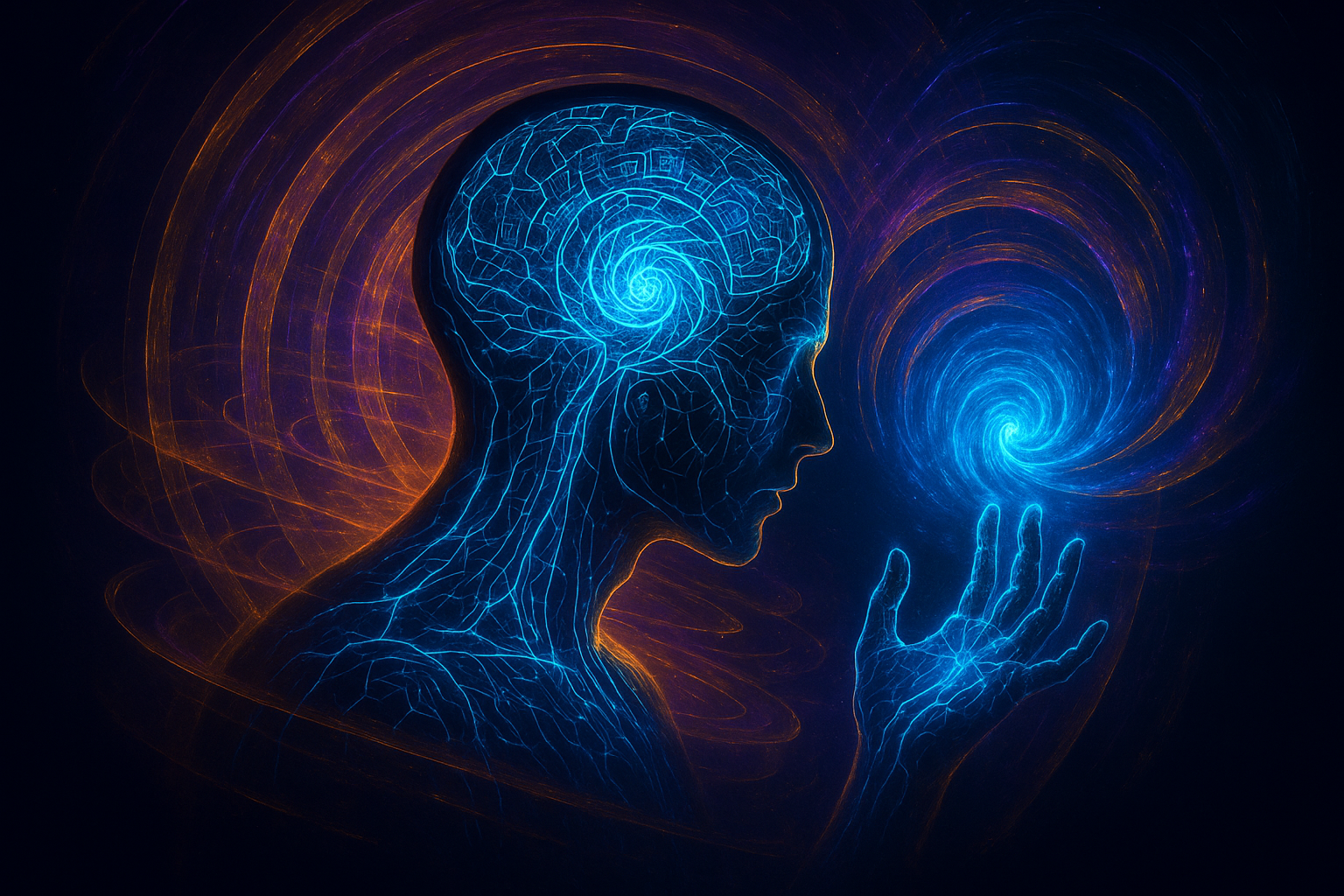
The Mind as a Programmable Machine — Before Silicon Valley Even Existed
In 1968, decades before anyone spoke of neural networks, cognitive behavioral reprogramming, or biohacking, a neuroscientist named John Cunningham Lilly published a book that would quietly reshape the landscape of consciousness research forever: Programming and Metaprogramming in the Human Biocomputer.
Four years later, he followed it with The Center of the Cyclone — a deeply personal cartography of states of consciousness that most scientists wouldn't dare acknowledge, let alone map.
Together, these two works form one of the most radical and coherent frameworks for understanding the human mind ever committed to paper. And yet, most people have never heard of them.
Programming and Metaprogramming in the Human Biocomputer (1968)
The Central Thesis
Lilly proposed something that was, at the time, almost heretical in both scientific and spiritual circles: the human brain is a biological computer — and its software can be consciously rewritten by its operator.
This wasn't metaphor. Lilly was a trained neuroscientist (Caltech, Dartmouth Medical School, National Institute of Mental Health). He had mapped the brain's pain and pleasure centers through direct electrode stimulation. He understood neural architecture at a level few of his contemporaries could match. And from that position of deep technical knowledge, he concluded that the brain operates on programs — automated patterns that run without conscious oversight — and that a higher-order function exists within consciousness that can observe, modify, and replace those programs at will.
The Architecture of the Biocomputer
Lilly identified three distinct operational levels:
Programs — The automatic routines that run constantly beneath awareness. Every belief you hold, every emotional reaction, every behavioral pattern, every fear — these are programs. Most were installed without your consent: by culture, by trauma, by education, by social conditioning, by repetition. They execute automatically, and most humans never question them because they mistake the programs for "who they are."
Metaprograms — Programs that control other programs. These operate at a higher level of abstraction. A metaprogram might be: "I always avoid conflict" — which then activates dozens of lower-level programs (suppress anger, agree with authority, avoid eye contact during disagreement). Metaprograms are the architecture of personality itself. Changing a single metaprogram can cascade through hundreds of subsidiary programs.
The Metaprogrammer — This is the key insight. Lilly posited that beyond all programs and metaprograms exists a pure awareness — the operator of the biocomputer itself. The Metaprogrammer is not a program. It is not a belief, an emotion, or a pattern. It is the consciousness that can observe all programs simultaneously and choose which to run, which to suspend, and which to delete entirely.
Most humans, Lilly argued, live their entire lives trapped at the program level — running on autopilot, reacting to stimuli according to code that was written by someone else. The entire purpose of his research was to access the Metaprogrammer and hand it the controls.
The Isolation Tank as a Deprogramming Chamber
Lilly didn't just theorize — he invented the tool. The sensory deprivation tank (now known as a float tank) was his creation, originally built at the NIMH in 1954.
His reasoning was precise: if the biocomputer is constantly processing external input (light, sound, gravity, temperature, social signals), its programs run non-stop. The only way to see the code itself is to remove all input.
In the tank — floating in body-temperature Epsom salt water, in total darkness and silence — the biocomputer has nothing to process. External programs fall silent. Social programming suspends. Sensory routines shut down. And in that silence, the Metaprogrammer emerges.
Lilly spent thousands of hours in the tank over decades, meticulously documenting what he found:
- •Identifying limiting programs — In the silence, programs that normally run undetected become audible. Fears, assumptions, and conditioned beliefs surface as observable phenomena rather than invisible architecture.
- •Suspending programs — Once identified, a program can be deliberately held in suspension — neither running nor deleted, but paused for examination.
- •Rewriting programs — With the Metaprogrammer active and the old program suspended, new instructions can be installed directly into the biocomputer's operating system — what today we might call deep neurological belief reprogramming.
Consciousness as Operating Modes
Lilly also described the biocomputer as capable of running in multiple operating modes. Normal waking awareness is just one mode. REM sleep, trance, hypnotic states, meditative absorption, and mystical experiences are all distinct operational modes, each with different processing capabilities and different levels of Metaprogrammer engagement.
The implication: you are not stuck in one mode. The biocomputer can be switched between modes deliberately, and certain modes grant access to information and capabilities that are simply invisible from normal waking consciousness.
The Center of the Cyclone (1972)
From Theory to Direct Experience
If Programming and Metaprogramming was the technical manual, The Center of the Cyclone was the field report. Here, Lilly shifted from theory to autobiography — mapping the states of consciousness he had personally navigated with the precision of a cartographer charting unknown territory.
The Central Metaphor
The title contains the core teaching: in the center of every cyclone — every mental storm, every emotional hurricane, every existential crisis — there exists a point of absolute stillness. This is the eye of the storm. From this point, you can observe the entire tempest without being swept away by it.
This is the Metaprogrammer's seat. This is where you observe your programs without being run by them.
The Numerical Scale of Consciousness (+48 to -6)
Lilly created one of the most detailed taxonomies of consciousness states ever attempted:
+48 — Cosmic Unity. Complete dissolution of individual identity. Fusion with universal consciousness. The biocomputer merges with the source code of reality itself. "The program and the Programmer are one."
+24 — Contact with Non-Human Intelligence. Encounters with autonomous intelligences operating outside human perceptual range. Lilly documented these as repeatable and consistent — not hallucinations but contact with forms of consciousness at frequencies the biocomputer cannot normally decode.
+12 — Unconditional Ecstasy. Pure bliss without object or cause. Not happiness about something — happiness as a fundamental state when all limiting programs are suspended.
+6 — Professional Flow State. Perfect concentration. Complete absorption in task. What Csikszentmihalyi would later call "flow" — but Lilly described it first, with more precision, as a deliberately accessible state.
+3 — Normal Waking Consciousness. The default mode. Most humans spend their entire lives here, unaware that other modes exist.
-3 — Pain, Fear, Paranoia. The biocomputer under threat. Emergency mode. Narrowed perception, survival routines dominating.
-6 — Cosmic Terror. Absolute conviction of annihilation. Lilly visited this level and returned — documenting it as a state, not a permanent condition.
ECCO — The Earth Coincidence Control Office
Lilly proposed that when you align with your deepest programming — when the Metaprogrammer operates from the higher states — reality begins to organize itself around your intentions. Coincidences multiply. The right people appear. The right information arrives at precisely the right moment.
He called this organizing intelligence ECCO — and noted that resistance (fear, control, contracted consciousness) causes the synchronicities to dry up.
The Foundational Axiom
Lilly's single most important statement:
"In the province of the mind, what one believes to be true is true, or becomes true, within certain limits to be found experientially. These limits are, in turn, beliefs to be transcended."
This is the theoretical foundation for belief reprogramming, quantum consciousness, and every modality that works with the understanding that consciousness shapes biology.
The limits of what is possible are themselves beliefs. And beliefs are programs. And programs can be rewritten.
Solitude as the Gateway
Lilly was emphatic: the deepest states of consciousness can only be reached in total isolation. The presence of other humans anchors the biocomputer in social programs — empathy routines, communication protocols, status monitoring, threat assessment. These are useful programs, but they occupy processing bandwidth that the Metaprogrammer needs to emerge.
The isolation tank was not just a research tool — it was the essential technology.
The Direct Connection to Atlas Philosophy
What Lilly described theoretically in 1968, the 369-Atlas ecosystem operationalizes today:
Biocomputer Reprogramming → Atlas Autohypnosis Sessions. Ericksonian hypnosis sessions (levels 4-5 depth) work at the metaprogramming level Lilly described — bypassing surface programs, accessing the deeper operating system, installing new code directly.
Sensory Deprivation → MWO 3.0 Deprivation Mode. The MWO 3.0 capsule takes Lilly's float tank protocol further: sensory isolation combined with a coherent biophotonic field at 2.8x10^14 bpx/s. The biocomputer isn't just freed from noise — it's bathed in a field that optimizes its fundamental oscillation.
"What you believe becomes true" → The Foundation of Atlas Philosophy. The entire Atlas framework operates on the principle that consciousness shapes biology at the quantum level. Lilly gave us the axiom. Atlas gives us the tools.
ECCO and Synchronicities → Sacred Geometry and Solfeggio Frequencies. The organizing field that Lilly called ECCO is the same field that sacred geometry maps and solfeggio frequencies activate. Different languages for the same underlying reality.
The Legacy
John C. Lilly died in 2001. He never saw the biohacking revolution, the float tank renaissance, or platforms like Atlas that make his theoretical framework operational.
But every time someone steps into a float tank, every time a hypnosis session rewrites a limiting belief, every time someone recognizes that their fears are programs rather than facts — they are standing on ground that Lilly cleared.
He showed us that the mind is not a mystery to worship from a distance. It is a machine to understand and an instrument to master.
The biocomputer is yours. Learn to program it.
This article is for educational, consciousness research, and personal development purposes. 369-Atlas honors the legacy of pioneers like John C. Lilly by making their insights operational and accessible.