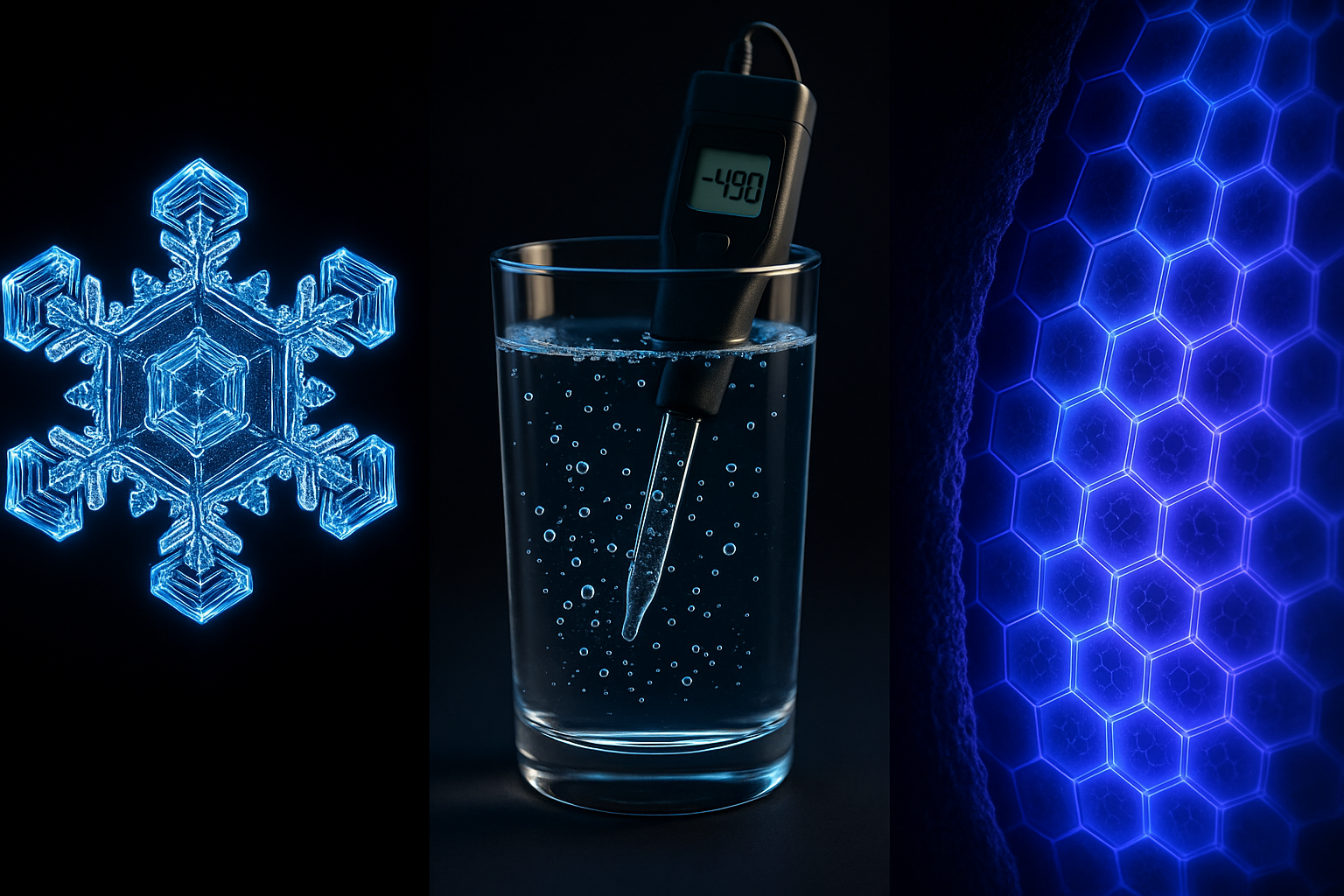
Why Most Water Advice Is Wrong
Search "best water for health" and you'll find alkaline water companies claiming pH is everything, hydrogen water brands claiming dissolved H2 is everything, and structured water vendors claiming vortexing is everything. Most of it is marketing built on a single kernel of truth, then stretched beyond recognition.
The reality is that water is the most studied and least understood substance on Earth. It has over 70 anomalous properties that no other liquid shares. And the science that matters — the science with real peer-reviewed evidence — points to a few specific, measurable parameters that determine whether the water you drink is biologically active or biologically inert.
This article covers what those parameters are, how to measure them, and how to optimize them — from a $20 home setup to a $6,000 clinical-grade system.
Part 1: What Water Actually Is — Beyond H2O
The Textbook Model Is Incomplete
Every chemistry textbook teaches that water is H2O — two hydrogen atoms covalently bonded to one oxygen. This is correct but incomplete. In bulk liquid water, individual H2O molecules don't exist in isolation. They form dynamic hydrogen-bonded networks that constantly rearrange on picosecond timescales.
What matters biologically is not the isolated molecule but the structure of these networks — how organized, how coherent, and how energetically they behave at biological interfaces.

Gerald Pollack's Fourth Phase: H3O2 (Exclusion Zone Water)
In 2013, Professor Gerald Pollack of the University of Washington published The Fourth Phase of Water (Ebner & Sons), summarizing over a decade of laboratory research that revealed something textbooks had missed entirely.
When water contacts a hydrophilic (water-loving) surface — such as a cell membrane, collagen fiber, or Nafion polymer — it spontaneously forms a distinct zone up to several hundred micrometers thick. This zone has properties radically different from bulk water:
| Property | Bulk Water (H2O) | EZ Water (H3O2) |
|---|---|---|
| Formula | H2O | H3O2 (empirically measured) |
| Structure | Disordered, rapidly fluctuating | Hexagonal liquid-crystalline lattice |
| Charge | Neutral | Net negative charge (up to -200 mV) |
| Viscosity | Low (1 cP) | Higher (gel-like) |
| Light absorption | Minimal | Absorbs at 270 nm UV |
| Excludes solutes | No | Yes — excludes particles, dyes, proteins |
| Energy source | N/A | Infrared radiation (radiant energy) |
Key Discovery
EZ water grows when exposed to infrared light (including body heat at ~37°C). This means your body continuously generates EZ water at every hydrophilic membrane surface — and it does so using thermal infrared energy as fuel. The implications for cellular biology are profound.
The evidence is robust:
- •Pollack, G.H. (2013). The Fourth Phase of Water: Beyond Solid, Liquid, and Vapor. Ebner & Sons Publishers.
- •Zheng, J.M., et al. (2006). "Surfaces and interfacial water: Evidence that hydrophilic surfaces have long-range impact." Advances in Colloid and Interface Science, 127(1), 19–27. DOI: 10.1016/j.cis.2006.07.002
- •Chai, B., et al. (2009). "Effect of radiant energy on near-surface water." Journal of Physical Chemistry B, 113(42), 13953–13958. DOI: 10.1021/jp908163w
- •Pollack, G.H., et al. (2009). "Exclusion zone dynamics studied by microelectrode measurements." Langmuir, 25(18), 10802–10806.
Why EZ Water Matters for Your Body
Your cells are not bags of ordinary water. Approximately 99% of the molecules inside a cell are water, and most of that water exists in contact with hydrophilic protein surfaces (cytoskeletal filaments, membrane surfaces, collagen matrices). Pollack's research suggests that a significant fraction of intracellular water exists as EZ water — structured, negatively charged, and energetically distinct.
This has implications for:
- •Cell voltage and membrane potential — EZ water provides a natural battery (negative charge)
- •Protein folding — the structured water shell around proteins influences their conformation
- •Nutrient transport — EZ zones create charge-driven flow without ATP expenditure
- •Mitochondrial function — the inner mitochondrial membrane is a prime EZ-generating surface
Emoto's Ice Crystal Photography: Art or Science?

Dr. Masaru Emoto's ice crystal photographs — showing beautiful hexagonal crystals from "blessed" water and deformed crystals from "cursed" water — captured worldwide attention. The scientific community largely dismissed this work due to methodological concerns: selection bias (choosing which crystals to photograph), lack of blinding, and no peer-reviewed replication.
However, the underlying principle that water structure varies and can be influenced by physical conditions is well-established:
- •Temperature gradients during freezing determine crystal morphology
- •Dissolved mineral content affects crystal formation
- •Electromagnetic fields measurably alter water's hydrogen bonding network
- •Vortexing and flow patterns change measurable parameters (surface tension, viscosity, ORP)
The honest position: Emoto's specific claims about intention affecting water are not scientifically validated. But the broader principle — that water structure is dynamic, variable, and responsive to physical inputs — is supported by mainstream physics.
Reference: Emoto, M. (2004). The Hidden Messages in Water. Beyond Words Publishing. (Note: popular science, not peer-reviewed research.)
Part 2: ORP — The Most Important Water Parameter You're Not Measuring
What Is ORP?
Oxidation-Reduction Potential (ORP) measures a liquid's tendency to either donate electrons (reduce) or accept electrons (oxidize). It is measured in millivolts (mV) using a standard ORP electrode.
| ORP Value | Meaning | Examples |
|---|---|---|
| +200 to +600 mV | Strongly oxidizing | Tap water, chlorinated water, bottled water |
| +50 to +200 mV | Mildly oxidizing | Most mineral waters |
| 0 to +50 mV | Neutral | Some spring waters |
| 0 to -200 mV | Mildly reducing | Fresh juice, antioxidant-rich liquids |
| -200 to -800 mV | Strongly reducing | Molecular hydrogen water, ionized water |

Why ORP Matters
Your body's internal environment operates at a negative ORP. Intracellular fluid has an ORP of approximately -70 to -100 mV. When you drink water with a highly positive ORP (+300 to +500 mV, which is typical tap water), your body must spend antioxidant resources to neutralize that oxidative load before the water becomes biologically useful.
Drinking water with a negative ORP means the water arrives pre-loaded with electrons — it acts as a liquid antioxidant.
Critical Distinction
When to use +ORP water: Disinfection, wound cleaning, surface sanitization. Oxidizing water kills pathogens effectively — this is why chlorinated (+ORP) water is safe for municipal supply. Hypochlorous acid (HOCl) at +800 to +1100 mV is a powerful medical-grade disinfectant.
When to use -ORP water: Drinking, cooking, cellular hydration. Reducing water supports the body's antioxidant systems, reduces oxidative stress, and mimics the internal electrochemical environment of healthy cells.
The Molecular Hydrogen Connection
The primary mechanism by which water achieves a negative ORP is dissolved molecular hydrogen (H2). When metallic magnesium contacts water:
Mg⁰ + 2H₂O → Mg(OH)₂ + H₂↑The dissolved H2 is the active reducing agent. It is the smallest molecule in existence, capable of penetrating every cell membrane, crossing the blood-brain barrier, and reaching mitochondria directly.
Key research:
- •Ohsawa, I., et al. (2007). "Hydrogen acts as a therapeutic antioxidant by selectively reducing cytotoxic oxygen radicals." Nature Medicine, 13(6), 688–694. DOI: 10.1038/nm1577
- •Ohta, S. (2014). "Molecular hydrogen as a preventive and therapeutic medical gas." Pharmacology & Therapeutics, 144(1), 1–11. DOI: 10.1016/j.pharmthera.2014.04.006
- •Ichihara, M., et al. (2015). "Beneficial biological effects and the underlying mechanisms of molecular hydrogen." Current Pharmaceutical Design, 21(35), 5066–5078.
- •Over 1,800 peer-reviewed papers on molecular hydrogen published since 2007 (source: molecularhydrogeninstitute.org)
Part 3: Simple Home Methods (Budget-Friendly)
Method 1: Magnesium Spheres in a Glass Pitcher ($15–25)

The simplest and most effective home method. Purchase 99.9% pure magnesium spheres (3–5 mm diameter) from any laboratory supplier or Amazon.
Setup:
- Fill a Big Blue 20" housing (or a glass pitcher with a mesh insert) with 500g of magnesium spheres
- Pour filtered water through the spheres (or let it soak for 15–30 minutes)
- Measure ORP — you should see -150 to -400 mV depending on contact time and water temperature
Why it works: Metallic magnesium (Mg⁰) reacts with water to produce dissolved H2 and Mg(OH)₂. The dissolved H2 drops ORP dramatically. The Mg(OH)₂ raises pH slightly (to ~8.5–9.5), but this is a side effect, not the primary benefit. The primary benefit is the dissolved hydrogen.
Maintenance: Replace magnesium spheres every 3–6 months as the metallic surface oxidizes. A thin white coating of Mg(OH)₂ forms — this is normal and non-toxic.
Method 2: Tourmaline Beads + Magnesium ($20–35)
Add tourmaline beads (30% by volume) to your magnesium sphere filter. Tourmaline is a naturally piezoelectric mineral — it generates a small electric charge when subjected to pressure or temperature changes. In water, this:
- •Contributes a supplementary negative charge
- •Emits far-infrared radiation (4–14 µm wavelength)
- •May promote EZ water formation at the tourmaline surface (hydrophilic mineral)
Reference: Niwa, Y., et al. (1993). "Natural mineral tourmaline emits far-infrared radiation." Journal of Chemical Engineering of Japan, 26(5), 518–522.
Method 3: Vortexing with a Hand Mixer ($0)

Viktor Schauberger, the Austrian naturalist and water researcher (1885–1958), observed that natural spring water always moves in vortex patterns — spiraling, never flowing in straight lines. He theorized that vortex motion is how nature structures water.
Simple home method:
- Fill a glass jar with filtered water
- Stir vigorously with a spoon or hand mixer, creating a vortex for 30–60 seconds
- Reverse direction and repeat
This won't change ORP or dissolve H2, but it may alter water's surface tension and cluster structure. The scientific evidence for vortex structuring is limited but suggestive:
- •Measurable: Vortexed water shows reduced surface tension (from ~72 to ~65 dyn/cm)
- •Not yet proven: Whether this translates to improved biological activity in humans
Reference: Schauberger, V. Compiled works available through the Schauberger Institute, Bad Ischl, Austria. Also: Coats, C. (1996). Living Energies. Gateway Books.
Method 4: Morning Sun in Blue or Violet Glass (Free)
Pollack's research shows that infrared light grows the exclusion zone in water. Sunlight is the most abundant natural IR source available — and morning sun is its gentlest, most infrared-rich window.
Protocol:
- Fill a blue or violet glass bottle with filtered water — the colored glass filters harsh visible light while passing the near-infrared and violet bands that drive EZ growth
- Place it in direct morning sun for 2–4 hours
- Use glass, not plastic (plastic leaches under UV)
This is the principle behind "sun-charged water" traditions found in Ayurveda, Russian folk medicine, and Mediterranean cultures. It costs nothing beyond the bottle, and the bottle doubles as your daily storage vessel: sun it in the morning, drink it through the day.
Method 5: Harmonic Frequency Exposure — 432 Hz, 528 Hz, 7.83 Hz ($0)
Rife-style acoustic structuring: water organizes in response to coherent vibration. The phenomenon is visible cymatics — the same standing-wave patterns Ernst Chladni demonstrated with sand on vibrating plates, and Hans Jenny documented frame by frame in liquids.
Protocol:
- Place your glass or bottle of water on or directly in front of a speaker
- Play a single pure tone — 432 Hz, 528 Hz, or 7.83 Hz — for 5–15 minutes
- Keep the volume low. The key is coherence, not power — a gentle, pure tone held steadily does more than loud sound
The frequencies:
- •432 Hz — the natural tuning standard used for most of recorded history, mathematically aligned with geometric patterns found throughout nature
- •528 Hz — the "miracle tone" of the ancient Solfeggio scale, associated in modern practice with repair and regeneration
- •7.83 Hz — the Schumann resonance: the base electromagnetic heartbeat of the Earth–ionosphere cavity, the frequency your brain settles into in calm, receptive states
Reference: Jenny, H. (1967). Cymatics: A Study of Wave Phenomena and Vibration. Basilius Presse.
Method 6: Vortex + Neodymium Magnet ($10–20)
The Method 3 vortex upgraded with a static magnetic field:
Protocol:
- Tape a small N52 neodymium disc magnet to the outside bottom of a glass jar — north pole facing the water
- Stir clockwise for 2–3 minutes, keeping a stable vortex funnel
- Drink within minutes, while the motion is still settling
Moving water crossing a static field gradient induces weak organizing forces, and the vortex itself measurably reduces surface tension (see Method 3). This won't shift ORP — that's chemistry — but as a structural layer on the vortex it costs almost nothing.
Method 7: Partial Freezing — the Hailstone Method ($0)
The oldest purification-and-structuring technique on Earth. Nature's version is the hailstone.
Protocol:
- Fill a glass container with filtered water and freeze until roughly 70% is ice (typically overnight)
- Pour off and discard the remaining liquid — this is where the impurities concentrate
- Keep the ice. Let it melt at room temperature and drink the meltwater cold
Why it works: as water freezes, the hexagonal crystal lattice excludes nearly everything that isn't water — chlorine, VOCs, and dissolved solids are pushed into the last-to-freeze liquid. Discarding that fraction leaves the purest, most structurally coherent water you can produce at home. Ice is a perfect hexagonal lattice — the same geometry EZ water adopts at biological surfaces — and meltwater near 0 °C retains short-range order that room-temperature water has lost.
Method 8: Written Intention — Labels on the Bottle ($0)
Masaru Emoto's most practical legacy isn't the microscope. It's the label.
Protocol:
- Write the words that carry the state you are choosing: Love, Health, Strength, Hope, Eternal
- Print them on water-resistant labels (any office supply store, or seal paper labels under clear tape)
- Fix them to the outside of your water bottle or jar
The label works 24 hours a day, on every refill, with zero attention required. Whether the mechanism is informational — as Emoto's crystal photography suggests — or the daily re-anchoring of intention, which no one disputes, it costs nothing and compounds daily.
Method 9: Pure Copper Vessels ($20–50)
Ayurveda has prescribed water stored overnight in copper — tamra jal — for thousands of years. Modern science confirms the core mechanism:
Protocol:
- Fill an unlined, pure copper bottle with filtered water
- Let it stand overnight (minimum 6–8 hours)
- Drink through the day; refill each evening
Why it works:
- •Oligodynamic effect: copper surfaces release trace Cu²⁺ ions — a broad-spectrum antimicrobial so effective that copper–silver ionization is EPA-registered water treatment (the same technology used in the clinical systems described in Part 4)
- •Interfacial ordering: copper is a highly hydrophilic metal — exactly the kind of surface where Pollack's lab showed exclusion-zone water nucleates
- •Trace mineral delivery: the nanogram quantities of ionic copper that dissolve are in the biologically available form your enzymes use
Practical notes: never store acidic liquids (citrus juice, vinegar, carbonated drinks) in copper, and buy solid copper, not copper-lined steel.
The MWO Synergy Protocol: Structured Water + Quinton
The Ideal Combination
Structured water with a trace of Quinton isotonic marine plasma, taken immediately before and immediately after every MWO session. Structured water is the conductor that multiplies the penetration of the field — charge the medium first, then broadcast.
Your body is over 99% water molecules by count. Every cell, every fascia plane, every extracellular matrix is a water-based liquid crystal — and the MWO field does not act on "cells" as solid objects. It acts on the water matrix they live in.
This is why hydration state is the single most under-appreciated variable in energy medicine outcomes: a coherent, structured, mineralized water matrix is a conductor; a dehydrated, disordered one is a resistor. Water structured by any of the methods above, with a trace of Quinton (isotonic marine plasma — the full mineral spectrum of seawater in the exact ratio your blood plasma carries), taken immediately before and after each session:
- •Before: saturates the matrix the field is about to propagate through
- •After: supplies the mineral substrates the energized water needs to hold charge and complete the biological cascade
The Zero-Effort Setup
If you recommend only one thing to clients, make it this: a pure copper bottle with an intention label fixed to the outside.
It requires zero daily effort, zero rituals, zero minutes of anyone's time — and it structures every refill automatically, 24 hours a day, while delivering trace ionic copper. Sun it in the morning when convenient (Method 4), play it a tone while you're in the room (Method 5), and it keeps working when you don't.
Part 4: Sophisticated Methods — Water Ionizers and Clinical Systems
Kangen / Alkaline Water Ionizers ($1,500–$5,000)
How they work: Electrolysis cells split water at platinum-coated titanium electrodes. The cathode side produces alkaline, hydrogen-rich, negative-ORP water. The anode side produces acidic, oxidizing, positive-ORP water.
| Output | pH | ORP | Use |
|---|---|---|---|
| Alkaline stream | 8.5–11.0 | -200 to -800 mV | Drinking |
| Acidic stream | 2.5–6.5 | +600 to +1100 mV | Cleaning, disinfection, skin care |
| Neutral stream | 7.0 | ~0 mV | Medication (no interaction) |
What they do well:
- •Produce genuinely hydrogen-rich, negative-ORP water on demand
- •The acidic byproduct (hypochlorous acid at 2.5 pH) is a legitimate medical-grade disinfectant
- •Adjustable pH/ORP settings for different applications
What they don't do:
- •They do NOT filter water — you still need pre-filtration for contaminants
- •The alkalinity is primarily from electrolysis (NaOH, KOH), not from dissolved minerals
- •The dissolved H2 dissipates within 4–8 hours if stored in an open container
Recommended models (quality/price):
- •Kangen SD501 (Enagic) — $4,280 — 7 platinum plates, medical-grade, Japanese manufacturing
- •AlkaViva Athena H2 — $1,995 — SMPS power, 7 plates, NSF-certified filters
- •Tyent UCE-13 Plus — $3,995 — 13 plates, self-cleaning, touchscreen
- •Budget alternative: Chinese OEM models on Alibaba ($200–$600) — same electrolysis principle, lower build quality, unverified plate coatings
Important Consideration
The alkalinity produced by electrolysis (without mineral contact) is "empty alkalinity" — the pH is high but the buffering capacity is low. This is different from naturally alkaline mineral water where the alkalinity comes from dissolved calcium, magnesium, and bicarbonates. Both approaches produce negative ORP, but mineral-contact methods provide additional nutritional benefit.
The 369-Atlas Clinical Water System

Our clinical-grade system was originally designed for the MWO 3.0 Sensory Deprivation Capsule, where patients float in magnesium sulfate solution. The system processes and maintains therapeutic water quality continuously. Here is the complete architecture:
System Flow: 8-Stage Clinical Water Processing
Stage 1 — Sediment Pre-Filter
Big Blue 20" housing with 5 µm cartridge. Captures macro debris (hair, skin flakes, crystallized salt, particulates). Standard practice — protects downstream stages.
Stage 2 — Activated Carbon (Coconut Shell)
Big Blue 20" housing with granular activated carbon (GAC). Adsorbs organic compounds (body oils, sweat metabolites, dissolved organics), chlorine, and chloramines. Does NOT remove dissolved minerals — this is intentional, as we want to preserve the MgSO₄ electrolyte.
Stage 3 — UV-C Sterilization
55W inline reactor with quartz sleeve. Broad-spectrum germicidal action against bacteria, viruses, and algae spores. No chemical residue. Critically, UV-C does not affect ORP or water chemistry — it sterilizes without oxidizing.
Stage 4 — Magnesium + Tourmaline (1st Pass)
Big Blue 20" housing loaded with 70% metallic magnesium spheres (3–5 mm, 99% purity) and 30% tourmaline beads. This is the primary ORP reduction stage:
Mg⁰ + 2H₂O → Mg(OH)₂ + H₂↑Dissolved H₂ is the active reducing agent. Tourmaline (piezoelectric) adds supplementary negative charge and far-infrared emission. Expected ORP after this stage: -200 to -350 mV.
Stage 5 — Magnesium (2nd Pass)
Big Blue 20" housing with 100% magnesium spheres. Extended contact time doubles H₂ saturation. This second pass is essential in high-ionic-strength MgSO₄ solutions, where the Mg⁰ reaction rate is slower due to Le Chatelier equilibrium (high Mg²⁺ concentration in solution shifts equilibrium backward). Expected ORP after dual pass: -350 to -550 mV.
Stage 6 — Inline Heater (Titanium)
3 kW PTC element with titanium wetted parts (salt-resistant). Precise thermostat control via PT100 sensor (±0.3°C). PTC (Positive Temperature Coefficient) elements are self-regulating — they cannot overshoot. Titanium resists MgSO₄ corrosion indefinitely.
Stage 7 — Viktor Schauberger Vortex Turbines
Counter-rotating pair (clockwise + counter-clockwise) with implosion geometry. This is the Schauberger double-vortex principle:
- •Vortex action incorporates dissolved H₂ into the water structure (prevents H₂ escape as surface bubbles)
- •Creates conditions favorable for EZ water formation
- •Counter-rotation maximizes turbulence at the vortex interface
We use commercial Schauberger vortex units from Dynamized Technologies S.A. (Belgium) — sealed units with natural magnetism and mineral frequency structuring.
Stage 8 — Cu/Ag Ionizer
Inline electrodes releasing 0.2 ppm Cu²⁺ and 0.02 ppm Ag⁺. Broad-spectrum antimicrobial without oxidants. This replaces ozone, bromine, or peroxide — all of which would destroy the negative ORP we worked so hard to create. Copper and silver ions persist in water, providing residual antimicrobial protection.
Reference for Cu/Ag ionization: Silvestry-Rodriguez, N., et al. (2007). "Silver as a disinfectant." Reviews of Environmental Contamination and Toxicology, 191, 23–45. DOI: 10.1007/978-0-387-69163-3_2
Pumps:
- •P1 (Peristaltic, silicone tube): 1–2 L/min, <15 dB — used during patient sessions. Vibration-isolated. Patient cannot perceive flow.
- •P2 (Centrifugal, variable speed): 6–10 L/min — used between sessions for high-throughput processing. Processes full tank volume in 15–20 minutes.
Sensors:
- •ORP probe: live -mV display with alert if above -200 mV (indicates Mg depletion)
- •PT100 temperature probe: ±0.1°C for heater and pad control
- •Return via laminar diffuser plate (1mm perforated) for silent, non-turbulent return to tank
Part 5: How to Measure Your Water
Essential Equipment
| Instrument | What It Measures | Cost | Recommendation |
|---|---|---|---|
| ORP meter | Redox potential (mV) | $30–$80 | Apera AI209 or HM Digital ORP-200 |
| pH meter | Acidity/alkalinity | $20–$50 | Apera PH20 |
| TDS meter | Total dissolved solids (ppm) | $10–$20 | HM Digital TDS-3 |
| H2 meter | Dissolved hydrogen (ppb) | $150–$300 | Trustlex ENH-1000 (gold standard) |
What to Look For
Ideal drinking water parameters:
| Parameter | Optimal Range | Why |
|---|---|---|
| ORP | -100 to -400 mV | Reducing/antioxidant |
| pH | 7.5 to 9.0 | Mildly alkaline (from minerals, not electrolysis alone) |
| TDS | 100–300 ppm | Contains beneficial minerals |
| Dissolved H2 | 500–1600 ppb | Therapeutic range per clinical literature |
| Temperature | Room temp or body temp | Cold water suppresses digestive enzymes |
The 30-Second Test
If you can only buy one instrument, buy an ORP meter. Dip it in your water. If the reading is above +200 mV, your water is oxidizing your cells. If it's below -100 mV, your water is actively supporting your antioxidant systems. This single measurement tells you more about your water's biological value than pH, TDS, and brand name combined.
Part 6: Practical Decision Matrix
Which Method Is Right for You?
| Your Situation | Recommended Method | Budget | Expected ORP |
|---|---|---|---|
| Budget-conscious, apartment | Mg spheres in glass pitcher | $15–25 | -150 to -300 mV |
| Family home, daily use | Big Blue 20" + Mg spheres + carbon pre-filter | $60–100 | -200 to -400 mV |
| Health-conscious, moderate budget | Water ionizer (AlkaViva/Tyent) | $2,000–4,000 | -300 to -600 mV |
| Practitioner / clinic | Full clinical system (described above) | $3,000–6,000 | -350 to -550 mV |
| Portable / travel | Hydrogen water bottle (PEM electrolysis) | $50–150 | -200 to -400 mV |
| Zero-effort, set-and-forget | Copper bottle + intention label (Methods 8 + 9) | $20–50 | Trace Cu²⁺ + structured every refill |
What NOT to Spend Money On
- •Alkaline water drops — raise pH without changing ORP. No dissolved H2. Marketing.
- •Alkaline filter pitchers (most brands) — raise pH marginally via mineral beads. ORP barely changes. Minimal benefit.
- •"Structured water" devices with no mechanism — spinning a magnet near a pipe does not produce measurable changes in any water parameter. Demand ORP readings.
- •Reverse osmosis alone — removes contaminants (good) but also removes ALL minerals and produces +200 to +300 mV water (bad). Must be remineralized and reduced after RO.
Part 7: The Science Summary
What Is Proven (Peer-Reviewed, Replicated)
- Dissolved molecular hydrogen (H2) is a selective antioxidant — over 1,800 peer-reviewed papers since Ohsawa et al. (2007) in Nature Medicine
- Water ORP is measurable and correlates with redox activity — standard electrochemistry
- EZ water (exclusion zone) exists and has distinct properties — Pollack lab, University of Washington, replicated independently
- Magnesium metal produces dissolved H2 in water — basic chemistry (Mg⁰ + 2H₂O → Mg(OH)₂ + H₂↑)
- UV-C sterilizes without affecting ORP — standard water treatment science
- Cu/Ag ionization provides broad-spectrum antimicrobial action — EPA-registered technology
What Is Promising (Published, Not Yet Fully Replicated)
- EZ water plays a biological role in cells — Pollack's theoretical framework, supported by indirect evidence
- Tourmaline far-infrared emission affects water structure — published but limited independent replication
- Vortex motion alters water properties — measurable surface tension changes, biological effects uncertain
- Freeze-melt cycling and copper storage alter measurable water properties — freeze concentration is established physics; the biological impact of the resulting meltwater is not yet quantified
What Is Not Proven
- Water has memory — no reproducible evidence
- Intention affects water crystal formation — Emoto's claims, not peer-reviewed or replicated
- Alkaline pH alone provides health benefits — the benefit comes from dissolved H2 and negative ORP, not pH itself
- Hexagonal water clusters persist at room temperature — NMR evidence shows clusters break and reform on picosecond timescales
References
- Pollack, G.H. (2013). The Fourth Phase of Water: Beyond Solid, Liquid, and Vapor. Ebner & Sons Publishers. ISBN: 978-0962689536
- Zheng, J.M., et al. (2006). "Surfaces and interfacial water." Advances in Colloid and Interface Science, 127(1), 19–27.
- Chai, B., et al. (2009). "Effect of radiant energy on near-surface water." J. Phys. Chem. B, 113(42), 13953–13958.
- Ohsawa, I., et al. (2007). "Hydrogen acts as a therapeutic antioxidant." Nature Medicine, 13(6), 688–694.
- Ohta, S. (2014). "Molecular hydrogen as a preventive and therapeutic medical gas." Pharmacol. Ther., 144(1), 1–11.
- Ichihara, M., et al. (2015). "Beneficial biological effects of molecular hydrogen." Curr. Pharm. Des., 21(35), 5066–5078.
- Silvestry-Rodriguez, N., et al. (2007). "Silver as a disinfectant." Rev. Environ. Contam. Toxicol., 191, 23–45.
- Niwa, Y., et al. (1993). "Tourmaline emits far-infrared radiation." J. Chem. Eng. Japan, 26(5), 518–522.
- Coats, C. (1996). Living Energies. Gateway Books. (Viktor Schauberger compiled works)
- Emoto, M. (2004). The Hidden Messages in Water. Beyond Words Publishing.
- Del Giudice, E., et al. (2010). "Water as a free electric dipole laser." Physical Review Letters, 61(9), 1085–1088.
- Molecular Hydrogen Institute. Research database: molecularhydrogeninstitute.org (1,800+ papers indexed)
- Jenny, H. (1967). Cymatics: A Study of Wave Phenomena and Vibration. Basilius Presse.
- Sentman, D.D. (1995). "Schumann Resonances." In Handbook of Atmospheric Electrodynamics, Vol. 1. CRC Press.
- Sudha, V.B., et al. (2012). "Storing drinking-water in copper pots kills contaminating diarrhoeagenic bacteria." Journal of Health, Population and Nutrition, 30(1), 17–21.